Download
1 / 23
230 likes | 367 Views
This project explores cache replacement algorithms using Poisson processes for webserver and microprocessor caches. We examine the motivation behind improving cache efficiency due to the growing memory-processor speed gap. Our study focuses on Maximum Likelihood Estimators to predict cache replacements and evaluates the performance compared to the widely used Least Recently Used (LRU) algorithm via simulations. While results show zero miss rates in some benchmarks, they reveal deficiencies in our predictive model, suggesting the need for further refinement and exploration of correlation parameters.

E N D
Poisson Processes and Maximum Likelihood Estimator for Cache Replacement A Preliminary Attempt ECEn 670 Semester Project Wei Dang Jacob Frogget
Outline • Motivation • Cache replacement algorithms • Poisson processes in webserver-based cache • Poisson processes in microprocessor-based cache • Maximum Likelihood estimator • Predicting procedures • Simulation and evaluation • Results compared to LRU • Future work
Motivation • Memory-processor speed gap is getting larger
One of the Solutions • Memory hierarchy • L1/L2/L3 • closer to chip, less latency, but smaller size • Cache replacement • Cache is fast but limited in size • conflict • Good replacement policies needed on contention
Cache Replacement Algorithms • Cache conflict in a 4-way associative cache Set index
Common Cache Replacement Algorithms • Random • Least Recently Used (LRU, most widely used) • Least Frequently Used • FIFO
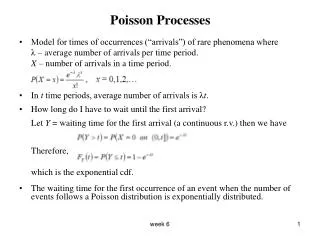
Poisson Processes for webserver cache • Arrival time of queries to a webserver can be modeled as a Poisson Process • Interpretation: the probability of having k queries up to some point of time • Assumption • Arrivals of queries are independent of each other • Not always true but valid for most cases
Poisson Processes for microprocessor cache • Independence assumption invalid • References to cache are highly correlated (especially to data cache) • Temporal locality • Spatial locality
Poisson Processes for microprocessor cache cont. • One Poisson process for each block within a set Set index An example set from a 4-way associative cache
Poisson Processes for microprocessor cache cont. • Correlation between these four random processes One global counter n for each set Set index Local counters to each block
Maximum Likelihood Estimator The estimate is the arithmetic mean of
Predicting Procedures • Initially each block has • Given a previous calculated for block , the estimated is calculated as: • Probabilities for replacement is then • Replace block with lowest probability • Choose randomly on equal probabilities
Simulation and Evaluation • Simulator: MyDLX cache simulator from EE628 • Metrics: miss rate for Instruction-cache and Data-Cache • Various associativities • Five benchmarks • Compared to LRU
Results • Results not encouraging • Sometimes 0% miss rate for both algorithms (might be due the inherent characteristics of benchmarks) • Statistical approach worse than LRU for most cases • Getting worse for higher associativity (more blocks to predict)
Analysis of deficiencies of our model • Independence model may be inaccurate (even accesses to the same block within a set may not be independent) • Local counter is reset to 0 on eviction (history eliminated)
Future work and challenges • More accurate model with more correlation parameters for each Poisson process • Implementation complexity (hardware expensive; LRU is already expensive at high associativity) • May be implemented as a software cache as a supplement to hardware cache.
The End Thank you! Questions?