Understanding Poisson Processes: Definitions, Applications, and Properties
This document by Shane G. Henderson explores the traditional definition of Poisson processes, highlighting their relevance in various applications, such as customer arrival times and ambulance call locations. It discusses the Palm-Khintchine theorem, point-process definitions, and the significance of superposition and transformation in generating these processes. The paper also addresses the independence of thinned and retained points and provides insights into marking and generating Poisson processes across different dimensions. This comprehensive overview makes complex concepts intuitive and accessible.

Understanding Poisson Processes: Definitions, Applications, and Properties
E N D
Presentation Transcript
Poisson Processes Shane G. Henderson http://people.orie.cornell.edu/~shane
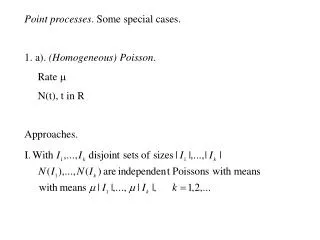
A Traditional Definition Shane G. Henderson
What Are They For? Times of customer arrivals (no scheduling and no groups) Locations, e.g., flaws on wafers, ambulance call locations,submarine locations Ambulance call times and locations (3-D) Shane G. Henderson
“Palm-Khintchine Theorem” time Shane G. Henderson
A Point-Process Definition Shane G. Henderson
Poisson Point-Processes Shane G. Henderson
Superposition Shane G. Henderson
Transformations Shane G. Henderson
Inversion t Shane G. Henderson
Marking This “works” because oforder-statistic property t Shane G. Henderson
Thinning Thinned points and retained points are in different regions,therefore independent “t” coordinates of retained points are a Poisson process, rate “t” coordinates of thinned points are too, rate i.i.d.U(0,1) t Shane G. Henderson
More on Marking • Suppose call times for an ambulance follow a Poisson process in time • Mark each call with the call location (latitude, longitude) • Resulting 3-D points are those of a Poisson process Shane G. Henderson
More on Marking To generate Poisson processes in > 1 dimension, one way is to • First generate their projection onto a lower dimensional structure (Poisson) • Independently mark each point with the appropriate conditional distribution Saltzman, Drew, Leemis, H. (2012). Simulating multivariate non-homogeneous Poisson processes using projections. TOMACS Shane G. Henderson
This View of Poisson Processes • Is mathematically elegant • Is highly visual and therefore intuitive • Makes proving many results almost as easy as falling off a log • Try proving thinned and retained points are independent Poisson processes • Suggests other generation algorithms Shane G. Henderson