Download
1 / 25
250 likes | 376 Views
This chapter explores the concepts of acids and bases, including their definitions and chemical behavior. Examples of common acids such as vinegar, lemon juice, and battery acid are provided, alongside bases like baking soda and ammonia. The text covers acid-base theories, including Arrhenius, Bronsted-Lowry, and Lewis theories, each defining acids and bases based on proton and electron transfer. Key topics include the properties of acids and bases, their strength, and neutralization reactions, forming a comprehensive overview of these fundamental chemical concepts.

E N D
Chapter 15 Acids and Bases
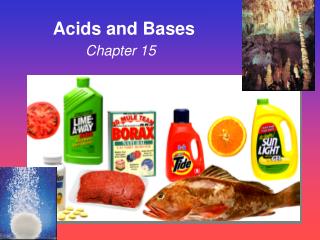
ACIDS • Examples of acids: • Vinegar • Lemon Juice • Soft Drink • Battery Acid • Stomach Acid • Apple Juice • Black Tea
ACIDS produce solutions that: • Taste sour • Turn blue litmus paper red • Conduct electricity • React with metals to liberate a hydrogen gas • Are corrosive (acid rain) • React with bases to form salt and water
BASES • Examples of bases: • Detergent • Baking Soda • Drain Cleaner • Ammonia • Soaps (hand, dish) • Antacid
Bases produce solutions that: • taste bitter • turn red litmus blue • conduct electricity • feel slippery • are corrosive (basic solution in glass container) • reacts with acids to form salt and water
ACID-BASE THEORIES There are three common acid-base theories: • the Arrhenius theory • the Bronsted-Lowry theory • the Lewis theory
SUMMARY OF ACID-BASE THEORIES THEORY ACID DEFINITION BASE DEFINITION Any substance which releases H+ ion in water solution. Any substance which releases OH- ions in water solution. Arrhenius Theory Any substance which donates a proton/hydrogen ion. Any substance which accepts a proton/hydrogen ion. Bronsted-Lowry Theory Lewis Theory Any substance which can accept an electron pair. Any substance which can donate an electron pair.
Arrhenius Theory • Svante Arrhenius was a Swedish chemist. • In 1887, he published a paper concerning acids and bases. • He concluded that solutions with acids and bases in them released particles when dissolved. • He concluded that acids were substance which separated (ionized) in water solution to produce hydrogen ions (H+, or free protons). • He also believed that bases were substance which ionized to produce hydroxide ions (OH-) in water solution.
Acid/Base reactions: Neutralization Produce water and a salt (and sometimes carbon dioxide). Hint: concentrate on the water first. Remember, water has the formula HOH. Complete and balance the following: HCl + KOH HOH + KCl HCl + Ca(OH)2 2 2HOH + CaCl2 Require equal numbers
1. Ba(OH)2 + H3PO4 2. HC2H3O2 + NaOH 3. H2SO4 + KOH 4. H2CO3 + NaOH 5. Na2CO3 + HCl
BRONSTED-LOWRY THEORY • T. M. Lowry was an English scientist, while J. N. Bronsted was a Danish scientist. • In 1923, they independently proposed a new definition of the terms acid and base. • They stated that in a chemical reaction, any substance which donates a proton/hydrogen ion is an acid and any substance which accepts a proton/hydrogen ion is a base. Bronsted Lowry
HF + H2O F - + H3O+ Acid Base Conjugate Conjugate Base Acid Acids lose a hydrogen to become a conjugate base Bases gain a hydrogen to become a conjugate acid Conjugates:
Example: Determine the acid, base, conjugate acid, and conjugate base in each of the following equations: HCl + H2O Cl- + H3O+ Acid Base Conjugate Conjugate Base Acid H2SO4 + H2O HSO4- + H3O+ Acid Base Conjugate Conjugate Base Acid NH3 + H2O OH- + NH4+ Base Acid Conjugate Base Conjugate Acid
What is the conjugate base of the following substances? H2O ________________ NH4+________________ HNO2_______________ HC2H3O2_________________ 3. What is the conjugate acid of the following substances? HCO3-__________________ H2O____________ HPO42-____________ NH3___________
LEWIS THEORY • Gilbert Newton Lewis was and American chemist. • In 1923, proposed an even broader definition of acids and bases. • Lewis focused on electron transfer instead of proton transfer. • He defined and acid as an electron-pair acceptor, and a base as an electron-pair donor. • This definition applies to solutions and reactions which do not even involve hydrogen or hydrogen ions. • His theory is used in organic chemistry.
Strong and Weak Acids/Bases The strength of an acid (or base) is determined by the amount ofIONIZATION.
Strong Acids/Bases:an acid that ionizes (separates into ions) completely or very nearly completely in aqueous solutions Weak Acids/Bases:an acid that ionizes only slightly in dilute aqueous solutions My uncle was a chemist, a chemist he's no more for what he thought was H 2 O was H 2 S O 4. (Ha Ha) Strong and Weak Acids/Bases
Let’s examine the behavior of an acid, HA, in aqueous solution. HA What happens to the HA molecules in solution?
100% dissociation of HA HA H+ Strong Acid A- Would the solution be conductive?
Partial dissociation of HA HA H+ Weak Acid A- Would the solution be conductive?
HA H+ + A- HA H+ Weak Acid A- At any one time, only a fraction of the molecules are dissociated.
Strong Acids: 100% ionized (completely dissociated) in water. HCl + H2O H3O+ + Cl- Strong Acids: Perchloric HClO4 Chloric, HClO3 Hydrobromic, HBr Hydrochloric, HCl Hydroiodic, HI Nitric, HNO3 Sulfuric, H2SO4
What is a strong Base? A base that is completely dissociated in water (highly soluble). NaOH(s) Na+ + OH- Strong Bases: Group 1A metal hydroxides (LiOH, NaOH, KOH, RbOH, CsOH) Heavy Group 2A metal hydroxides [Ca(OH)2, Sr(OH)2, and Ba(OH)2]