Download
1 / 10
100 likes | 266 Views
This resource covers essential concepts in sound waves, including terminology like wavelength, compression, and different wave features such as crests and troughs. It includes practice questions designed to assess understanding of sound wave characteristics, the mediums through which sound travels, and how sound interacts with different environments. Students will encounter questions about examples like blowing over a bottle and how sound behaves in a vacuum. Ideal for reviews or study sessions in physics or general science.

E N D
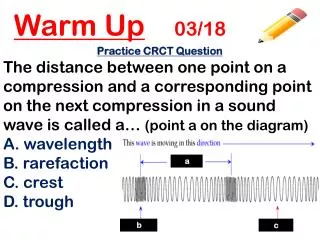
Warm Up03/18 Practice CRCT Question The distance between one point on a compression and a corresponding point on the next compression in a sound wave is called a… (point a on the diagram) A. wavelength B. rarefaction C. crest D. trough a B b c
Closing03/18 Practice CRCT Question The distance between a compression and the next compression in a sound wave is called a — (point c on the diagram) A. amplitude. B. rarefaction C. wavelength. D. trough. a B b c
Warm Up03/19 Practice CRCT Question Sound waves travel fastest through… air liquids solids a vacuum
Closing03/19 Practice CRCT Question Which of the following is not a medium? a. air b. space c. rope d. water
Warm Up03/20 Practice CRCT Question You blow over a bottle filled with water. The pitch is… A. high. B. low. C. The same as if the bottle was empty. D. The same as if the bottle was halfway filled with water.
Closing03/20 Practice CRCT Question What does number 2 in the diagram represent? a. crest b. trough c. amplitude d. wavelength
Warm Up03/21 Practice CRCT Question What does number 1 in the diagram represent? a. crest b. trough c. amplitude d. wavelength
Closing03/21 Practice CRCT Question What does number 3 in the diagram represent? a. crest b. trough c. amplitude d. wavelength
Warm Up03/22 Practice CRCT Question Imagine a ringing bell set inside a sealed glass jar. Why is the ringing no longer heard if the air is removed and a vacuum is created? A. The glass prevents any sound from escaping. B. The jar absorbs all of the sound waves. C. Without air, the sound waves cannot travel to the ear. D. The pressure of the outside air causes the sound to remain inside the jar.
Closing03/22 Practice CRCT Question What does number 4 in the diagram represent? a. crest b. trough c. amplitude d. wavelength