Search Engine Result Combining
320 likes | 398 Views
Learn about interpreting peptide identification results, overcoming search engine inconsistencies, and utilizing machine learning in biochemistry. Unify search results for more accurate peptide identification with PepArML.


Search Engine Result Combining
E N D
Presentation Transcript
Search Engine Result Combining Nathan Edwards Department of Biochemistry and Molecular & Cellular Biology Georgetown University Medical Center
Peptide Identification Results • Search engines provide an answer for every spectrum... • Can we figure out which ones to believe? • Why is this hard? • Hard to determine “good” scores • Significance estimates are unreliable • Need more ids from weak spectra • Each search engine has its strengths ...... and weaknesses • Search engines give different answers
Translation start-site correction • Halobacterium sp. NRC-1 • Extreme halophilic Archaeon, insoluble membrane and soluble cytoplasmic proteins • Goo, et al. MCP 2003. • GdhA1 gene: • Glutamate dehydrogenase A1 • Multiple significant peptide identifications • Observed start is consistent with Glimmer 3.0 prediction(s)
Halobacterium sp. NRC-1ORF: GdhA1 • K-score E-value vs PepArML @ 10% FDR • Many peptides inconsistent with annotated translation start site of NP_279651
Search engine scores are inconsistent! Tandem Mascot
Common Algorithmic Framework – Different Results • Pre-process experimental spectra • Charge state, cleaning, binning • Filter peptide candidates • Decide which PSMs to evaluate • Score peptide-spectrum match • Fragmentation modeling, dot product • Rank peptides per spectrum • Retain statistics per spectrum • Estimate E-values • Appy empirical or theoretical model
Comparison of search engines • No single score is comprehensive • Search engines disagree • Many spectra lack confident peptide assignment OMSSA Mascot 10% 4% 2% 69% 9% 5% 2% X!Tandem
Lots of techniques out there • Treat search engines as black-boxes • Generate PSMs + scores, features • Apply supervised machine learning to results • Use multiple match metrics • Combine/refine using multiple search engines • Agreement suggests correctness • Use empirical significance estimates • “Decoy” databases (FDR)
Machine Learning • Use of multiple metrics of PSM quality: • Precursor delta, trypsin digest features, etc • Requires "training" with examples • Different examples will change the result • Generalization is always the question • Scores can be hard to "understand" • Difficult to establish statistical significance • Peptide Prophet's discriminant function • Weighted linear combination of features
Combine / Merge Results Threshold peptide-spectrum matches from each of two search engines • PSMs agree → boost specificity • PSMs from one → boost sensitivity • PSMs disagree → ????? • Sometimes agreement is "lost" due to threshold... • How much should agreement increase our confidence? • Scores easy to "understand" • Difficult to establish statistical significance • How to generalize to more engines?
Consensus and Meta-Search • Multiple witnesses increase confidence • As long as they are independent • Example: Getting the story straight • Independent "random" hits unlikely to agree • Agreement is indication of biased sampling • Example: loaded dice • Meta-search is relatively easy • Merging and re-ranking is hard • Example: Booking a flight to Denver! • Scores and E-values are not comparable • How to choose the best answer? • Example: Best E-value favors Tandem!
Searching for Consensus Search engine quirks can destroy consensus • Initial methionine loss as tryptic peptide • Charge state enumeration or guessing • X!Tandem's refinement mode • Pyro-Gln, Pyro-Glu modifications • Difficulty tracking spectrum identifiers • Precursor mass tolerance (Da vs ppm) Decoy searches must be identical!
Configuring for Consensus Search engine configuration can be difficult: • Correct spectral format • Search parameter files and command-line • Pre-processed sequence databases. • Tracking spectrum identifiers • Extracting peptide identifications, especially modifications and protein identifiers
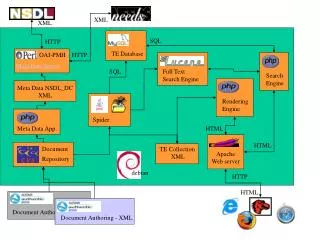
Simple unified search interface for: Mascot, X!Tandem, K-Score, S-Score, OMSSA, MyriMatch, InsPecT Automatic decoy searches Automatic spectrumfile "chunking" Automatic scheduling Serial, Multi-Processor, Cluster, Grid Peptide Identification Meta-Search
Peptide Identification Grid-Enabled Meta-Search X!Tandem, KScore, OMSSA, MyriMatch, Mascot (1 core). NSF TeraGrid 1000+ CPUs Heterogeneous compute resources X!Tandem, KScore, OMSSA. Secure communication Edwards Lab Scheduler & 80+ CPUs Scales easily to 250+ simultaneoussearches X!Tandem, KScore, OMSSA. Single, simplesearch request UMIACS 250+ CPUs
PepArML • Peptide identification arbiter by machine learning • Unifies these ideas within a model-free, combining machine learning framework • Unsupervised training procedure
PepArML Overview Feature extraction X!Tandem PepArML Mascot OMSSA Other
Dataset Construction X!Tandem Mascot OMSSA T F T …… T
Voting Heuristic Combiner • Choose PSM with most votes • Break ties using FDR • Select PSM with min. FDR of tied votes • How to apply this to a decoy database? • Lots of possibilities – all imperfect • Now using: 100*#votes – min. decoy hits
Application to Real Data • How well do these models generalize? • Different instruments • Spectral characteristics change scores • Search parameters • Different parameters change score values • Supervised learning requires • (Synthetic) experimental data from every instrument • Search results from available search engines • Training/models for all parameters x search engine sets x instruments
Conclusions • Combining search results from multiple engines can be very powerful • Boost both sensitivity and specificity • Running multiple search engines is hard • Statistical significance is hard • Use empirical FDR estimates...but be careful...lots of subtleties • Consensus is powerful, but fragile • Search engine quirks can destroy it • "Witnesses" are not independent