Understanding Products and Services through Deep Mind Mapping Techniques
This text explores the nature of products, emphasizing that they can be tangible goods, services, or even ideas. It contrasts surface mind mapping, which may lead to superficial learning, with deep mind mapping that promotes rich conceptual frameworks, enhancing long-term retention and understanding. Key strategies for effective mind mapping are also outlined, including focusing on central subjects, using colors, and creating connections. This approach aids in the retention and application of knowledge, essential for effective problem-solving in various contexts.

Understanding Products and Services through Deep Mind Mapping Techniques
E N D
Presentation Transcript
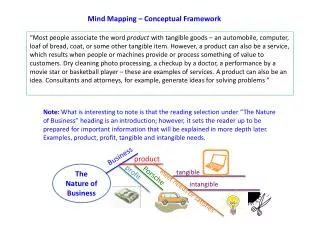
Mind Mapping – Conceptual Framework “Most people associate the word product with tangible goods – an automobile, computer, loaf of bread, coat, or some other tangible item. However, a product can also be a service, which results when people or machines provide or process something of value to customers. Dry cleaning photo processing, a checkup by a doctor, a performance by a movie star or basketball player – these are examples of services. A product can also be an idea. Consultants and attorneys, for example, generate ideas for solving problems ” Note: What is interesting to note is that the reading selection under “The Nature of Business” heading is an introduction; however, it sets the reader up to be prepared for important information that will be explained in more depth later. Examples, product, profit, tangible and intangible needs. Business product The Nature of Business tangible Porsche profit intangible meet needs or satisfies
Surface and Deep Mind Mapping • Surface Mind Mapping: One can mind map information fairly mindlessly by simply following the text clues in a textbook. However, merely moving information from the textbook to paper does not constitute a very effective strategy for developing conceptual frameworks. • “Surface learning is the unquestioning acceptance of information and memorization of facts without making any connections with prior knowledge. This most often does not result in long-term understanding or retention of the concepts being learned.” • Deep Mind Mapping: • Deep Mind mapping: One can alsomind map using cognitive strategies at each step along the way which helps the reader develop rich conceptual frameworks (neural networks) with which to make constructed meanings more likely to be used (thinking, reasoning, and problem-solving). • “Deep learning involves evaluating new ideas, connecting those ideas to knowledge the reader already knows, and results in understanding and long-term retention of concepts so that the ideas are useful - problem solving in unfamiliar contexts.” Learning becomes even deeper if new information being learned is organized into conceptual frameworks.
To make a mind map more effective the follow these 10 basic components: 1 .A map will begin with a subject at its center. 2. The use of color(s)is very helpful. 3. Branch off the center with key words or images 4.Use lower case print key word, and to make an idea stand out, use UPPER CASE PRINT 5. Important: each key word should have its own branch (line).(1pt) 6. All branches must be connected. 7. The length of a branch should be the same length as the key word. 8. The use of color for different branches is very helpful to recall of the information. 9. Use a visualization, such as a picture or drawing. 10. Map is neat. All printing right side up.
Mind Mapping – Conceptual Framework {Mind Mapping} – graphically organizing information to show connections, relationships and prior knowledge is among the most powerful techniques for developing conceptual frameworks of new concepts.