Southern Colonies
This chapter explores the agricultural foundations of the Southern colonies, highlighting the warm climate, long growing seasons, and fertile soil that made cash crops like rice, tobacco, and indigo thrive. It examines the pivotal role of plantations in shaping the Southern economy and culture, relying heavily on slave labor. As the population of enslaved Africans surged, their harsh living conditions and resistance efforts formed a significant part of this narrative. The text reveals the brutal realities of plantation life and the ongoing struggle for cultural identity among enslaved people.


Southern Colonies
E N D
Presentation Transcript
Southern Colonies Chapter 4 Notes
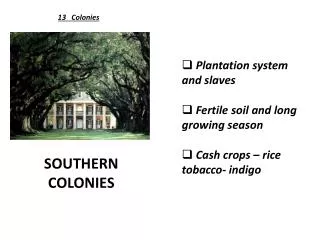
FARMING! FARMING! FARMING! A. WARM climate, LONG growing season (10-12 Months?, FERTILE soil B. Grew cash crops i. RICE– mostly in SC ii. Tobacco iii. INDIGO (BLUE dye – used to color cloth)
c. PLANTATIONS – LARGE farms used to grow cash crops i. Were the CENTER of Southern Economy/Culture (VERY IMPORTANT!) ii. Needed a large LABOR force (SLAVES) iii. Plantations were mainly SELF-SUFFICIENT • Grew, made, produced everything that they needed
2. Cities a. Very FEW cities – go ahead, count them… b. Most people lived on FARMS and PLANTATIONS i. People were farther apart and more ISOLATED
3. Slavery a. Grew rapidly in the mid to late 1600s i. By 1750, almost 40 PERCENT of Southern population were slaves (p. 120) ii. Southern ECONOMY largely depended upon slave labor iii. Brutal LIVING conditions 1. LONG work day 2. BEATEN/WHIPPED 3. poor HOUSING 4. no EDUCATION 5. work for LIFE with NO/LITTLE hope for FREEDOM
iv. Africans tried to maintain their CULTURE; MUSIC, dance, stories v. Resistance to slavery was in many forms 1. Worked SLOWLY 2. Purposely did things the WRONG way 3. Purposely BROKE tools 4. Ran away 5. Rebelled a. STONO Rebellion (1739) 1 .Rebellion often led to more difficult SLAVE CODES which made life EVEN WORSE for slaves