Understanding Population Growth Models: Exponential vs. Logistic
90 likes | 193 Views
Explore the dynamics of exponential and logistic population growth models, differential equations, and carrying capacity. Solve homework questions with examples and exercises from Sections 6.5 and 6.6 in this comprehensive study guide.


Understanding Population Growth Models: Exponential vs. Logistic
E N D
Presentation Transcript
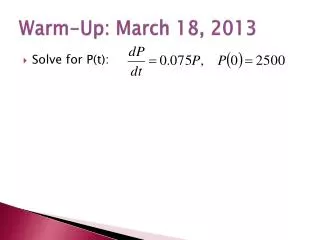
Warm-Up: March 18, 2013 • Solve for P(t):
Population Growth Section 6.5
Exponential Population Growth Model • Many populations grow at a rate proportional to the size of the population. • where k is the relative growth rate. • The resulting exponential growth model is • We usually use t=0 as the first year of our model
Example 1 • Springfield has a current population of 36000 and is growing at a relative rate of 2.3%. • Write a differential equation for the population. • Find a formula for the population P(t). • Superimpose the graph of the population function on a slope field for the differential equation.
Logistic Population Growth Model • Populations cannot increase forever. • Environmental factors often limit the population to some maximum value, M, called the carrying capacity. • The logistic growth model is found from the following logistic differential equation:
Example 2 • Find k and the carrying capacity for the population represented by
Logistic Growth Model • The solution to • Is given by • Where A is a constant found using the given initial condition
Assignment • Read Section 6.5 (pages 342-346) • Page 347 Exercises #1-15 odd • Read Section 6.6 (pages 350-355)