Download
1 / 7
70 likes | 200 Views
This outline delves into the dual court system of the United States, covering the intricate jurisdiction of federal and state courts. It explains the roles of state courts in handling state law cases versus federal courts, which manage cases related to federal laws, treaties, and constitutional interpretations. Key aspects include the structures of federal and Maryland state courts, the creation of district courts by Congress, and the distinctions between grand juries and petit juries in criminal cases. The overview also highlights the appellate process and the authority held by various court levels.

E N D
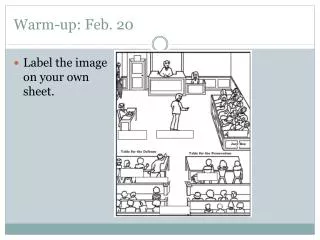
Warm-up: Feb. 20 Label the image on your own sheet.
Powers and Structure of the Dual (federal and state) Court System
I. Jurisdiction of the Courts A. The US has a dual court system of state and federal courts B. State courts have jurisdiction (authority) over cases involving state laws C. Federal courts have jurisdiction over cases involving US laws, foreign treaties and the interpretation of the Constitution D. In some cases, federal and state courts have concurrent jurisdiction E. In the federal court system, trial courts are district courts that have original jurisdiction; federal courts of appeals have only appellate jurisdiction (authority to hear cases appealed from district courts)
Powers of the Federal Courts A. The federal district courts were created by Congress as trial courts for both civil and criminal cases B. In criminal cases, there are two types of juries: a grand jury, which hears charges against a person accused of a crime, and a petit jury, or trial jury, which weighs the evidence presented at trial C. District courts carry the main burden in federal courts D. In the vast majority of cases, district courts render the final decision E. The 13 courts of appeals ease the appellate workload of the Supreme Court G. The courts of appeals may decide to uphold the original decision, reverse the decision, or send the case back to the original court to be tried again