Exploring Monochromatic Color Schemes: Elegance and Simplicity in Design
The monochromatic color scheme utilizes variations in lightness and saturation of a single color, creating a clean and elegant aesthetic. This approach produces a soothing effect, particularly with blue or green hues, making the design easy on the eyes. Integrating the primary color with neutral tones like black, white, or gray enhances its impact. While it offers balanced visuals, highlighting key elements can be challenging due to limited contrast. Using tints, shades, and tones effectively enhances the scheme, allowing for simplified beauty in design.


Exploring Monochromatic Color Schemes: Elegance and Simplicity in Design
E N D
Presentation Transcript
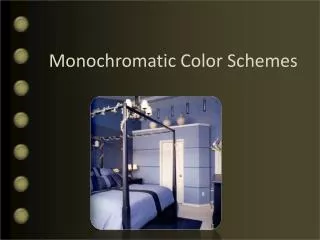
Monochromatic Color Scheme • The monochromatic color scheme uses variations in lightness and saturation of a single color. This scheme looks clean and elegant. Monochromatic colors go well together, producing a soothing effect. The monochromatic scheme is very easy on the eyes, especially with blue or green hues.
You can use it to establish an overall mood. The primary color can be integrated with neutral colors such as black, white, or gray. However, it can be difficult, when using this scheme, to highlight the most important elements. Pros: The monochromatic scheme is easy to manage, and always looks balanced and visually appealing. Cons: This scheme lacks color contrast. It is not as vibrant as the complementary scheme. Tips: 1. Use tints, shades, and tones of the key color to enhance the scheme.2. Try the analogous scheme; it offers more nuances while retaining the simplicity and elegance of the monochromatic scheme.