The Middle Ages: From the Fall of the Roman Empire to the Rise of the Merchant Class
140 likes | 257 Views
This exploration of the Middle Ages covers the fragmentation of the Roman Empire, Charlemagne's efforts to unify Europe, and the emergence of the Holy Roman Empire endorsed by the Pope. It examines the Viking raids that devastated regions across Europe, the feudal system, and the societal structure formed by fiefs, nobles, vassals, knights, manors, and serfs. The Crusades, sparked by a desire for control over the Holy Land, along with the devastating impact of the Black Death, reshaped Europe. Additionally, the era saw the rise of trade, education, and the decline of traditional power structures leading to the end of the Middle Ages by the late 15th century.


The Middle Ages: From the Fall of the Roman Empire to the Rise of the Merchant Class
E N D
Presentation Transcript
The Roman Empire falls apart. Charlemagne- tries to reunite parts of empire. Holy Roman Empire Endorsed by the Pope. The Vikings- Launch raids throughout much of Europe. Destroy many villages and cities. The “Dark” Ages
Fuedalism- a system for controlling land. King gives land in return for protection. Social Pyramid- formed the basic structure of medieval society. Key terms- Fief Nobles Vassals Knights Manors Serfs Life in the Middle Ages
The Crusades • Series of holy wars between Christians and Muslim Turks for control of the Holy Land. • Area today of Jerusalem and Palestine. • Four major crusades were launched- in the end control of holy land is lost to Muslims. • Leads to many important changes throughout Europe.
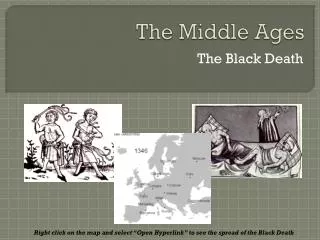
The Black Death • Bacterial disease spread by rats and fleas. • Victims often died within days to one week. • Over 1/3 of European population died as a result of the plague- Over 25 million people! • In some cities almost 800 people a day died.
More Black Death • “Ring around the Rosie”- some people say this rhyme refers to the black death. Bubo-first sign
The High Middle Ages • The Crusades had a HUGE effect on the growth of Europe. • Trade begins to grow • People want new goods from Asia- spices, gold, sugar, silk, and more. • The Silk Road- main route traveled by traders and merchants between China and Europe. • A new merchant class begins to grow into the social pyramid.
The power of kings and nobles begins to decrease. • Kingdoms begin to fall apart- replaced by national governments. • Large cities begin to grow- Paris, London, Rome. • Magna Carta- Document that limited the power of the king.
Education becomes increasingly important • More people learn to read and write- mainly to help with trade. • Books and literature become more widely available. • By the end of the1400’s, the Middle Ages come to an end.