Download
1 / 9
90 likes | 227 Views
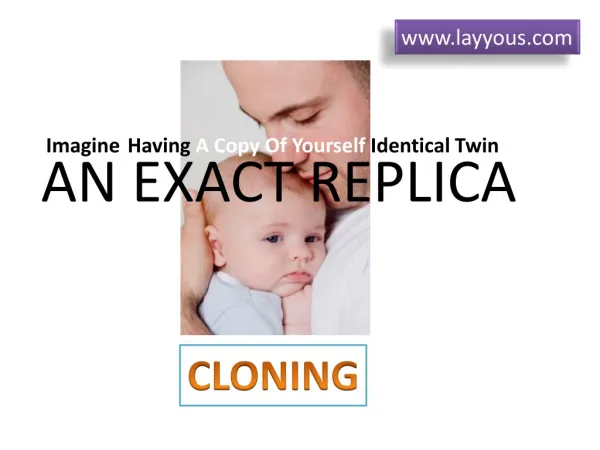
Cloning is a natural form of asexual reproduction that results in identical genetic offspring from a single cell. It occurs daily in nature and was first exemplified in 1958 when a carrot was cloned from a root cell. More complex cloning followed, including the groundbreaking achievement of Dolly the sheep in 1996, who was the first fertile mammal cloned from an adult cell. Cloning holds immense implications for science and ethical discussions, especially regarding human cloning. Should human cloning be allowed? Explore the arguments surrounding this controversial topic.

E N D
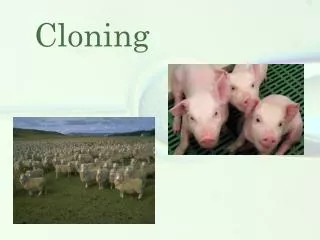
Cloning Cloning is the process of forming identical genetic offspring from a single cell. It is a natural process that happens daily in nature when organisms produce exact duplicates of themselves by asexual reproduction (binary fission, budding…). Cloning is referred to as asexual reproduction because the DNA originates from a single parent.
The First Clone • In 1958, Frederic Stewart was the first to “clone” something – a carrot, grown from a cell at its root tip. • The key to cloning seems to be in delaying specialization, so that all the genetic information gets transferred before any cells “turn off” some of it.
Cloning Animals • While cloning plants may not seem like that great of a feat, the cloning of animals may seem much more impressive. • Robert Briggs and Thomas King worked with frogs. They managed to remove the nucleus(enucleated) from an unfertilized egg and then replace that nucleus with that of a nucleus from a frog embryo in early development and the result was a frog that had characteristics of the donating embryo.
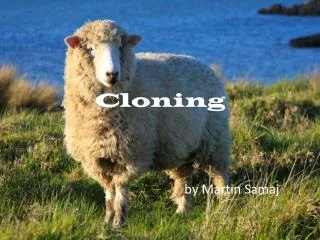
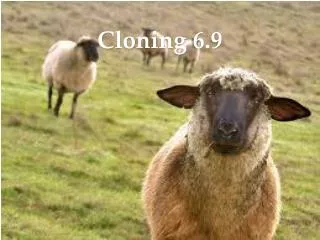
Dolly • In 1996, Dolly the sheep, a species much more complex than simple plants or amphibians, was cloned. • She was the first fertile clone! • This experiment rocked the scientific community because many scientists believed that cells that had specialized had lost their ability to create new organisms. They were wrong.
Genetic information from a FINN DORSET sheep.Enucleated ovum from a POLL DORSET sheep.Surrogate mother Blackface sheep.Offspring Clone of the FINN DORSET.
The Story of Dolly The Cloned Sheep • http://www.youtube.com/watch?v=tELZEPcgKkE
Human Clones • http://www.sciencechannel.com/tv-shows/through-the-wormhole/videos/through-the-wormhole-human-clones.htm
Journal Assignment • Please write a page discussing whether or not you believe cloning of humans should be allowed in Canada. Be sure to include at least three reasons to back up your position.