Evolution of Radio Technology: From Telegraphs to Mass Media Broadcasting
This overview explores the development of radio technology, highlighting key figures such as Samuel Morse with the telegraph, Heinrich Hertz's radio waves, and Guglielmo Marconi's wireless telegraph. It covers milestones like Reginald Fessenden's voice transmission, the emergence of scheduled broadcasts with KDKA, and the regulatory evolution from the Radio Act of 1912 to the Federal Communications Act of 1934. The transformation of radio into a mass media platform is examined alongside its adaptation to challenges such as television, leading to the diverse landscape of contemporary broadcasting.

Evolution of Radio Technology: From Telegraphs to Mass Media Broadcasting
E N D
Presentation Transcript
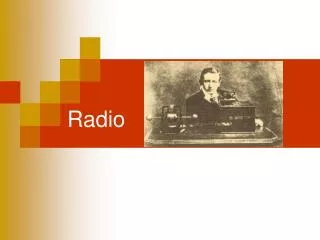
Technology Development • Samuel Morse- Electromagnet and telegraph • Heinrich Hertz- Radio waves • Guglielmo Marconi- Wireless telegraph • Voice over the Air • Reginald Fessenden- transmitted voice and record over air • Lee De Forest- audion tube (amplified signal and more portable) • Experimenters and hobbits start transmitting
Radio Becomes a Mass Media • 1916, Sarnoff memo at American Marconi (Radio Music Box) • Scheduled Broadcasts- KDKA in Pittsburgh (Frank Conrad/Westinghouse) • Chaos in the air- by 1923, 600 licenses • Major interference • Radio Act of 1912 no criteria for licenses
Regulating Broadcasting • Why regulate broadcasting? • 1903 Berlin Radio Conference • Radio Act of 1912 (Sec. of Commerce) • Radio Act of 1927 (Federal Radio Com.) • Federal Communications Act of 1934 (FCC) • Telecommunications Act of 1996
Federal Communications Commission • Public Airwaves • Federally Licensed • Public File • Media\FCCsong.wmv K W
Economics- How to pay for this? • Government operation • Subscription service • Leasing- common carrier • Endowment • Advertising- WEAF in NY
Mass Media • Early 20’s- start of marketing home receivers and by 1930 there were 14 million. • 1921 RCA and Sarnoff start NBC • CBS soon followed • In a single decade, radio is transformed from a long distance signal devices to a medium to serve the entire nation. • The depression and WWII free entertainment
Challenge of TV • Radio adapts- Birth of the DJ • Public Broadcasting • 1967 Public Broadcasting Act (CPB) • Growth of FM • Developed by Edwin Armstrong • AM almost died, but turned to Talk
Radio Today • 13,800 radio stations • 96% of population over 12 listens every week ( TV 90%, Paper 76%) • Inexpensive advertising (10-11% ad $) • Satellite Radio- Jan-Mar 2005- 540,000 new subscribers • Group Ownership
Ownership Numbers • Clear Channel Communications- 1,194 • Cumulus Broadcasting Inc.- 305 • Citadel Broadcasting Corp.- 220 • Infinity Broadcasting- 183 • Educational Media Foundation- 118
Goldstein, S. (2001, Winter) A report from the programming department. Feedback. Broadcast Education Association.
What Radio Formats People Listen To, 2002 Source: Arbitron ’Radio Today’ annual report
Radio Programming-Dayparts • Morning Drive 6-9 • Midday 9-2 • Afternoon Drive 2-6 • Night 6-12 • Overnight 12-6