Cellular Respiration
This overview compares aerobic and anaerobic metabolism, highlighting the key processes of glycolysis, the Krebs cycle, and fermentation. Glycolysis occurs in the cytoplasm, with pyruvate entering the Krebs cycle when oxygen is present, maximizing ATP yield through aerobic respiration (yielding 38 ATP) versus anaerobic fermentation (yielding only 2 ATP). Key processes in mitochondria, including electron transport and the role of oxygen as the final electron acceptor, are also discussed. Learn about the contrasting fates of pyruvate in different oxygen conditions.

Cellular Respiration
E N D
Presentation Transcript
Cellular Respiration Aerobic and Anaerobic Metabolism
Glycolysis Simplified (greatly ) If oxygen is available (aerobic), then pyruvate enters the Krebs cycle If oxygen is not available(anaerobic), then pyruvate undergoes fermentation
Synonymous Terms • Krebs cycle • Citric acid cycle • Tri-carboxylic acid cycle (TCA cycle)
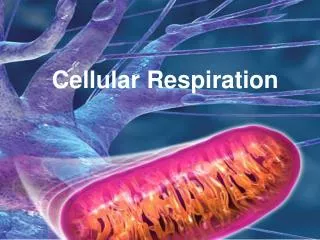
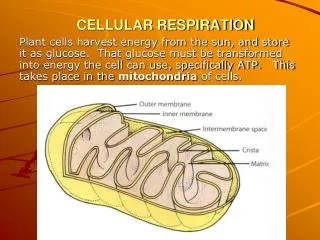
Mitochondrial Structure The Krebs cycle takes place across inner membrane space (matrix) of the mitochondrion
The Role of Oxygen (O2) Oxygen is the terminal (final) electron acceptor Oxygen is needed only in the very LAST step of cellular respiration! ½ O2 + 2H+ + 2e- H2O
Mitochondrial Structure Infoldings (cristae) increase the area of membrane surface available for electron transport
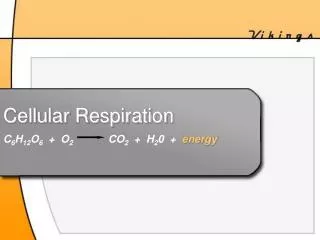
Aerobic Respiration C6H12O6 + 6O2 → 6CO2 + 6H2O + 38 ATP • The Krebs cycle and electron transport take place in the mitochondria • The Krebs cycle and electron transport maximize ATP yield • 38 ATPvs.2 ATP for fermentation
Anaerobic Respiration(Alcohol Fermentation) C6H12O6 → 2 CH3CH2OH + 2 CO2 + 2 ATP glucose ethyl alcohol carbon dioxide Alcohol fermentation takes place in yeast and some bacteria, and yields only the 2 ATP produced in glycolysis
Anaerobic Respiration(Lactic Acid Fermentation) C6H12O6 → 2 C3H6O3 + 2 ATP glucose lactic acid Lactic acid fermentation takes place in animal cells and some bacteria and fungi; it yields only the 2 ATP produced in glycolysis.