Download
1 / 50
500 likes | 610 Views
This text delves into the classification of living organisms based on the modern taxonomic hierarchy, including domains and kingdoms such as Bacteria, Archaea, Protista, Fungi, Plantae, and Animalia. It discusses significant differences between prokaryotic and eukaryotic cells, along with the evolutionary perspectives reflected in their structures and functions. The classification systems also illustrate the common characteristics and diversity of organisms ranging from unicellular bacteria to complex multicellular life forms. Key concepts like genetic variation, metabolic cooperation, and survival strategies are explored.

E N D
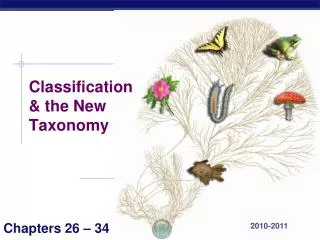
Classification & the New Taxonomy Chapters 26 – 34
Solar System Finding commonality in variety Earth • Organisms classified from most general group, _________, down to most specific, ________ • domain, kingdom, phylum, class, order, family, genus, species No. America U. S. N. Y. New York City Queens use the mnemonic! Forest Hills
Eukaryote Prokaryote Archaebacteria&Bacteria Classification • ______5 Kingdom system • Monera, Protists, Plants, Fungi, Animals • ______3 Domain system • reflects a greater understanding of evolution & molecular evidence • ________________________ • ________________________ • ________________________ • ____________ • ____________ • ____________ • ____________
KingdomBacteria KingdomArchaebacteria KingdomProtist KingdomFungi KingdomPlant KingdomAnimal
Fungi Animalia Kingdoms absorptivenutrition ingestivenutrition Plantae autotrophs heterotrophs Protista uni- tomulticellular multicellular Eubacteria Archaebacteria prokaryotes eukaryotes Single-celled ancestor
Domain Bacteria Domain Archaea Domain Eukarya Common ancestor Prokaryotes Domain Bacteria Domain Archaebacteria
Bacteria live EVERYWHERE! • Bacteria live in all ecosystems • on plants & animals • in plants & animals • in the soil • in depths of the oceans • in extreme cold • in extreme hot • in extreme salt • on the living • on the dead Microbes alwaysfind a way tomake a living!
Bacterial diversity rods and spheres and spirals… Oh My!
eukaryote cell prokaryotecell Prokaryote Structure • Unicellular • ______________________ • Size • ______________________ • 1 micron (1um) • Internal structure • __________________________ • no membrane-bound organelles • only ribosomes • __________________________ • not wrapped around proteins
Prokaryote vs. Eukaryote Chromosome Prokaryote Eukaryote double helix
Fig. 27-8 Chromosome Plasmids 1 µm
mitochondria chloroplast Variations in Cell Interior cyanobacterium(photosythetic) bacterium aerobic bacterium internal membranesfor respirationlike a mitochondrion(cristae) internal membranesfor photosynthesislike a chloroplast(thylakoids)
outer membrane of lipopolysaccharides __________________ __________________ peptide side chains outer membrane cell wall peptidoglycan cell wall peptidoglycan plasma membrane plasma membrane protein Prokaryote Cell Wall Structure That’simportant foryour doctorto know! __________________= polysaccharides + amino acid chains __________________= lipids + polysaccharides
Fig. 27-3 Carbohydrate portion of lipopolysaccharide Outer membrane Peptidoglycan layer Cell wall Cell wall Peptidoglycan layer Plasma membrane Plasma membrane Protein Protein Gram- positive bacteria Gram- negative bacteria 20 µm (b) Gram-negative: crystal violet is easily rinsed away, revealing red dye. (a) Gram-positive: peptidoglycan traps crystal violet.
Other prokaryotic cell structures • Capsule • Fimbriae • Sex pili
Fig. 27-4 200 nm Capsule
Fig. 27-5 Fimbriae 200 nm
Fig. 27-6 Flagellum Filament 50 nm Cell wall Hook Basal apparatus Plasma membrane
Prokaryotic metabolism • How do bacteria acquire their energy & nutrients? • ________________ • photosynthetic bacteria • ________________ • oxidize inorganic compounds • nitrogen, sulfur, hydrogen… • ________________ • live on plant & animal matter • decomposers & pathogens
The Role of Oxygen in Metabolism • Prokaryotic metabolism varies with respect to O2: • ________________require O2 for cellular respiration • ________________are poisoned by O2 and use fermentation or anaerobic respiration • ________________can survive with or without O2
Metabolic Cooperation • Cooperation between prokaryotes allows them to use environmental resources they could not use as individual cells
Fig. 27-14 Photosynthetic cells Heterocyte 20 µm
Fig. 27-15 1 µm
Reproduction and Adaptation • Prokaryotes reproduce quickly by binary fission and can divide every 1–3 hours • Many prokaryotes form metabolically inactive ______________, which can remain viable in harsh conditions for centuries
Fig. 27-9 Endospore 0.3 µm
Genetic variation in bacteria • Rapid Reproduction • bacteria can reproduce every 20 minutes • _________________ • Mutations • error rate in copying DNA • 1 in every 200 bacteria has a mutation • you have billions of E. coli in your gut! • lots of mutation potential! • Genetic recombination • bacteria swap genes • __________________ • __________________ • __________________ conjugation
Transformation and Transduction • A prokaryotic cell can take up and incorporate foreign DNA from the surrounding environment in a process called ____________________ • _________________is the movement of genes between bacteria by bacteriophages (viruses that infect bacteria)
Fig. 27-11-1 Phage DNA A+ B+ A+ B+ Donor cell
Fig. 27-11-2 Phage DNA A+ B+ A+ B+ Donor cell A+
Fig. 27-11-3 Phage DNA A+ B+ A+ B+ Donor cell A+ Recombination A+ A– B– Recipient cell
Fig. 27-11-4 Phage DNA A+ B+ A+ B+ Donor cell A+ Recombination A+ A– B– Recipient cell A+ B– Recombinant cell
Conjugation and Plasmids • Conjugation: __________________________________________________________________________ • ___________ allow cells to connect and pull together for DNA transfer • A piece of DNA called the ____________ is required for the production of sex pili • The F factor can exist as ________________ ___________ or as _____________________ ______________
Fig. 27-12 1 µm Sex pilus
Fig. 27-13 The F Factor as a Plasmid F plasmid Bacterial chromosome F+ cell F+ cell Mating bridge F– cell F+ cell Bacterial chromosome (a) Conjugation and transfer of an F plasmid Recombinant F– bacterium A+ Hfr cell A+ A+ A+ F factor A– A+ A– A+ A– A– F– cell (b) Conjugation and transfer of part of an Hfr bacterial chromosome
Fig. 27-13-1 Bacterial chromosome F plasmid F+ cell Mating bridge F– cell Bacterial chromosome (a) Conjugation and transfer of an F plasmid
Fig. 27-13-2 Bacterial chromosome F plasmid F+ cell Mating bridge F– cell Bacterial chromosome (a) Conjugation and transfer of an F plasmid
Fig. 27-13-3 Bacterial chromosome F plasmid F+ cell F+ cell Mating bridge F– cell F+ cell Bacterial chromosome (a) Conjugation and transfer of an F plasmid
Fig. 27-13-4 The F Factor in the Chromosome A+ Hfr cell A+ A+ F factor A– A– F– cell (b) Conjugation and transfer of part of an Hfr bacterial chromosome
Fig. 27-13-5 A+ Hfr cell A+ A+ A+ F factor A– A+ A– A– F– cell (b) Conjugation and transfer of part of an Hfr bacterial chromosome
Fig. 27-13-6 Recombinant F– bacterium A+ Hfr cell A+ A+ A+ F factor A– A+ A– A+ A– A– F– cell (b) Conjugation and transfer of part of an Hfr bacterial chromosome
R Plasmids and Antibiotic Resistance • R plasmids carry genes for antibiotic resistance • Antibiotics select for bacteria with genes that are resistant to the antibiotics • Antibiotic resistant strains of bacteria are becoming more common
Bacteria as pathogens • Disease-causing microbes • _________________ • wilts, fruit rot, blights • _________________ • tooth decay, ulcers • anthrax, botulism • plague, leprosy, “flesh-eating” disease • STDs: gonorrhea, chlamydia • typhoid, cholera • TB, pneumonia • lyme disease
Fig. 27-21 5 µm
Bacteria as beneficial (& necessary) • Life on Earth is dependent on bacteria • _______________________ • recycling of nutrients from dead to living • _______________________ • only organisms that can fix N from atmosphere • needed for synthesis of proteins & nucleic acids • plant root nodules • _______________________ • digest cellulose for herbivores • cellulase enzyme • produce vitamins K & B12 for humans • _______________________ • from yogurt to insulin
Fig. 27-22a (a)
Got any Questions?? Ask da’ BacterialBoss!
You should now be able to: • Distinguish between the cell walls of gram-positive and gram-negative bacteria • State the function of the following features: capsule, fimbriae, sex pilus, nucleoid, plasmid, and endospore • Explain how R plasmids confer antibiotic resistance on bacteria
Distinguish among the following sets of terms: photoautotrophs, chemoautotrophs, photoheterotrophs, and chemoheterotrophs; obligate aerobe, facultative anaerobe, and obligate anaerobe; mutualism, commensalism, and parasitism; exotoxins and endotoxins