Effect of Tin Precursors and Catalysts on Sol-Gel Process for Tin-Based Thin Films
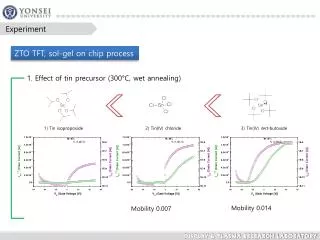
This experiment investigates the impact of different tin precursors and catalysts on the sol-gel process for fabricating tin-based thin films. Various tin compounds, including Tin isopropoxide, Tin(IV) chloride, and Tin(IV) tert-butoxide, are evaluated at temperatures of 300°C under both wet and dry annealing conditions. The role of acetic acid as a catalyst is also explored. The results reveal variations in mobility, indicating the influence of precursor choice and processing conditions on the material properties of the resulting films.

Effect of Tin Precursors and Catalysts on Sol-Gel Process for Tin-Based Thin Films
E N D
Presentation Transcript
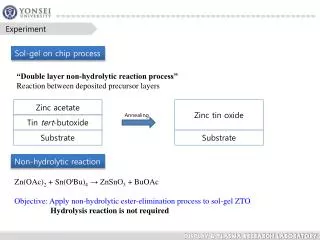
Experiment ZTO TFT, sol-gel on chip process 1. Effect of tin precursor (300°C, wet annealing) 1) Tin isopropoxide 2) Tin(IV) chloride 3) Tin(IV) tert-butoxide Mobility 0.014 Mobility 0.007
Result 2. Effect of catalyst (acetic acid) 300°C, dry annealing Acetic acid 1) Tin isopropoxide 2) Tin(IV) chloride 3) Tin(IV) tert-butoxide
2. Effect of catalyst (acetic acid) Tin tert-butoxide + Acetic acid Direct gelation
Experiment 실험 상세
Precursor Tin isopropoxide Dry 1) Tin isopropoxide Acetic acid Wet
Precursor Tin(IV) chloride Dry 2) Tin(IV) chloride Acetic acid Wet
Precursor Tin tert-butoxide Dry 3) Tin(IV) tert-butoxide Acetic acid Wet