Download

1 / 14
140 likes | 225 Views
Explore the vital functions of the respiratory system, from breathing to gas exchange in animals. Learn about the stages of respiration, cellular respiration, and the key organs involved in oxygen exchange. Detailed information on the lungs, alveoli, and the process of gas exchange.

E N D
RESPIRATION Respiration • supply O2 to & remove CO2 from all body cells 3 main stages:
RESPIRATION 1. Breathing Inspiration - taking air into the lungs Expiration - removing air from the lungs 2.External Respiration • exchange of O2 & CO2 between air and blood.
RESPIRATION 3. Internal Respiration • exchange of O2 & CO2 between blood and cells Cellular Respiration • chemical reactions that take place in the mitochondria to release energy from glucose
GAS EXCHANGE 3 requirements: 1. surface area must be large enough to occur very rapidly. 2. must take place in a moist environment 3. diffusion gradient must be maintained (move from higher conc to lower conc)
GAS EXCHANGE IN ANIMALS • respiratory pearson.notebook
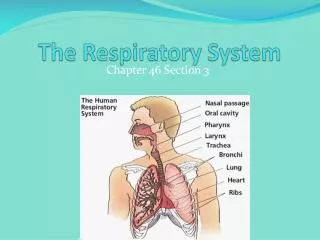
HUMAN RESPIRATORY SYSTEM Organs work together to move gases in and out of body
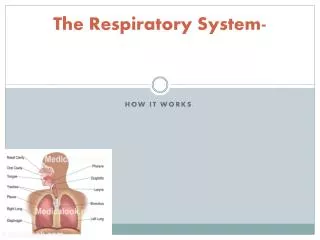
NASAL CAVITY • air enters nostrils or mouth • warmed and moistened in nasal cavity • passes through pharynx (throat), where the nasal cavity meets the oral cavity (for food)
PHARYNX • the glottis is the opening of the trachea(windpipe) that leads air to the lungs. • trachea is protected by the epiglottis, which prevents food from entering
LARYNX • larynx (voice box) is a small opening in the trachea controlled by muscles. • contains the vocal cordswhich vibrate to produce sounds. • pitch is determined by the length of the cord.
TRACHEA & BRONCHI • trachea supported by rings of cartilage -keep it from collapsing • branches into two forks called bronchi (now in lungs) • each bronchusbranches into smaller bronchioles
ALVEOLI • Bronchioles end in tiny air sacs, called alveoli. Gas exchange occurs in each alveolus. • surrounded by a network of capillaries which allow CO2andO2to diffuse.
LUNGS • right lung has 3 lobes • left lung has 2 lobes • heart fits between • surrounded by layers of tissue called pleura, (allows them to expand and retract)