Understanding the Human Skeletal System: Structure, Function, and Pathologies
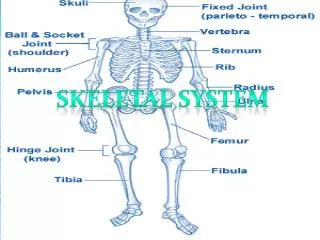
The human skeleton comprises 206 bones that serve as a supporting framework, protecting vital organs, aiding in movement, and acting as a mineral reservoir. This chapter explores bone structure, including the diaphysis, epiphysis, periosteum, and various types of bone. It highlights different bone markings and depressions relevant for muscle attachment and joint formation. Additionally, it covers major bone groups, including cranial, facial, vertebral, thoracic, pelvic, and limb bones. It also addresses pathological conditions affecting bone health, such as osteoporosis and osteomyelitis.

Understanding the Human Skeletal System: Structure, Function, and Pathologies
E N D
Presentation Transcript
Skeletal System CHAPTER 6
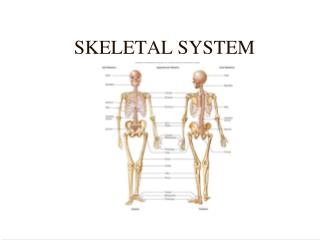
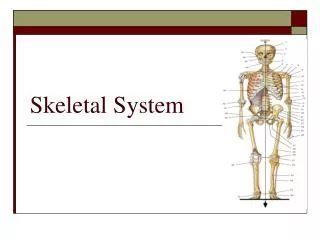
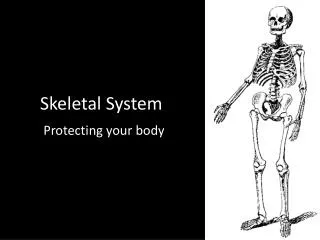
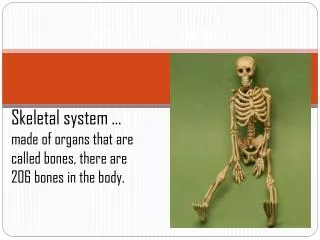
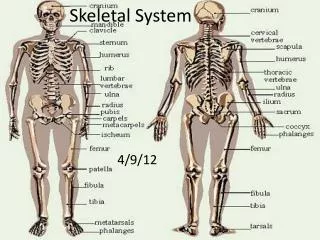
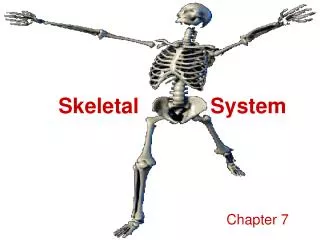
Skeletal System • Human skeleton consists of 206 bones • Serves as supporting framework of body • Protects vital internal organs • Important role in movement = attachments for muscles • Reservoir for storing minerals • Red bone marrow = blood cell formation
Bone Structure • Diaphysis • Main shaft-like portion of a long bone • Compact bone • Epiphysis • Located at each end of a long bone • Epiphyseal line • Separates diaphysis from epiphysis
Bone Structure • Periosteum • Covers the surface of the long bone • Articular cartilage • Covers joint surfaces • Medullary (marrow) cavity • Contains yellow marrow
Bone Structure • Spongy bone (trabeculae) • Also called cancellous bone • Red bone marrow • Site for blood cell production • Yellow marrow • Stores fat
Bone Markings • Bone markings = specific features of bones • Enlargements that extend out from the bone • Openings within the bone • Hollow regions within the bone • Points of attachment for muscles and tendons • Points for joining one bone to another • Cavities and passage for nerves and blood vessels
Bone Depressions • Concave areas or openings in a bone • Help form joints • Serve as points of attachment for muscle • Sulcus • Groove or depression in a bone • Example = fissure • Sinus • Opening or hollow space in a bone • Example = frontal sinus
Bone Depressions • Fossa • Hollow or shallow concave depression in bone • Example = fossa of the iliac (hip) bone • Foramen • Hole within a bone for blood vessels or nerves to pass through • Example = Foramen magnum of the skull
Cranial Bones • Cranium = bony skull • Envelops brain • Composed of eight bones • Immovable bones • Borders meet to form immovable joints • Immovable joints = sutures
Facial Bones • Two bones provide distinctive shape to face • Maxillae (upper jaw bones) • Mandible (lower jaw bone) • All facial bones connected by immovable joints (sutures) • One exception (mandible)
Vertebral Bones • Form long axis of the body • Referred to as spinal column or backbone • 24 vertebrae + sacrum + coccyx • Offer protection to spinal cord
Vertebral Bones • Cervical vertebrae • Vertebrae of the neck (cervic/o = neck) • Identified as C1 – C7 • Thoracic vertebrae • Vertebrae of the chest (thorac/o = chest) • Identified as T1 – T12 • Lumbar vertebrae • Vertebrae of lower back (lumb/o = lower back, loins) • Identified as L1-L5
Vertebral Bones • Sacrum • Singular, triangular shaped bone • Resulted from fusion of five individual sacral bones in the child • Coccyx • Also called “tailbone” • Resulted from fusion of four individual coccygeal bones in the child
Bones of the Thorax • True ribs (Ribs 1-7) • Attach to sternum in front and vertebrae in back • False ribs (Ribs 8-10) • Attach to vertebrae in back but attach to cartilage of 7th rib in front – not the sternum • Floating ribs (Ribs 11-12) • Attach to vertebrae in back • Completely free of attachment in front
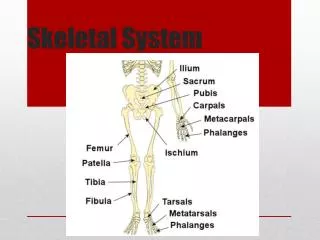
Bones of the Lower Extremities • Femur • Thigh bone • Patella • Knee bone or kneecap • Tibia • Larger and stronger of the two lower leg bones • Fibula • More slender of the two lower leg bones
Bones of the Ankle and Foot • Ankle bones (Tarsals) • Calcaneus • Talus bone • Foot bones • Metatarsals • Phalanges
PATHOLOGICAL CONDITIONS Skeletal System
Osteomalacia • Pronounced • (oss-tee-oh-mah-LAY-she-ah) • Defined • Abnormal softening of the bones due to a deficiency of calcium and phosphorus in the blood • Which is necessary for bone mineralization
Osteomyelitis • Pronounced • (oss-tee-oh-my-ell-EYE-tis) • Defined • A local or generalized infection of the bone and bone marrow • Resulting from a bacterial infection that has spread to the bone tissue through the blood
Osteoporosis • Pronounced • (oss-tee-oh-poh-ROW-sis) • Defined • Porous bones • Bones that were once strong become fragile due to loss of bone density
Ewing’s Sarcoma • Pronounced • (YOO-wings sar-KOH-mah) • Defined • Malignant tumor of the bones common to young adults, particularly adolescent boys
Osteogenic Sarcoma • Pronounced • (oss-tee-oh-JEN-ic sar-KOH-mah) • Defined • Malignant tumor arising from bone • Also known as osteosarcoma
Osteochondroma • Pronounced • (oss-tee-oh-kon-DROH-mah) • Defined • Most common benign bone tumor • Most frequently involves the femur and tibia
Paget’s Disease • Pronounced • (PAJ-ets dih-ZEEZ) • Defined • Nonmetabolic disease of the bone • Characterized by excessive bone destruction and unorganized bone formation by the osteoblasts • Bone is weak and prone to fractures
Spinal Stenosis • Pronounced • (SPIGH-nal stin-OH-sis) • Defined • Narrowing of the vertebral canal, nerve root canals, or intervertebral foramina • Openings of the lumbar spinal canal • Causes pressure on nerve roots prior to their exit from the foramina
Talipes Equinovarus • Pronounced • (TAL-ih-peez eh-kwine-oh-VAIR-us) • Defined • Clubfoot
Abnormal Curvature of the Spine • Kyphosis • Outward curvature = humpback or hunchback • Lordosis • Inward curvature = swayback • Scoliosis • Lateral (sideward) curvature
Fracture: Broken Bone • Closed fracture • Break in the bone but no open wound in skin • Simple fracture • Open fracture • Break in the bone, as well as an open wound in skin • Compound fracture
Fracture: Broken Bone • Complete fracture • Break extends through the entire thickness of bone • Incomplete fracture • One side of bone is broken and one side of bone is bent considerably but not broken • Greenstick fracture
Fracture: Broken Bone • Compression fracture • Caused by bone surfaces being forced against each other • Impacted fracture • Direct force causes bone to break • Forces broken end of smaller bone into broken end of larger bone
Fracture: Broken Bone • Colle’s fracture • Break occurs at lower end of the radius • Within one inch of connecting with wrist bones • Hairline fracture • Minor fracture in which the bone continues to be in perfect alignment • Also known as a stress fracture
Fracture: Broken Bone • Pathological fracture • Bone is weakened by a preexisting disease • Break is in response to a force that would not cause a normal bone to break • Treatment of fractures • Closed reduction • Open reduction
DIAGNOSTIC TECHNIQUES, TREATMENTS AND PROCEDURES Skeletal System
Diagnostic Techniques, Treatments, and Procedures • Bone scan • Intravenous injection of a radioisotope, which is absorbed by bone tissue • Followed by scanning of the skeleton approximately three hours later to detect areas where the bone absorbs the isotope
Diagnostic Techniques, Treatments, and Procedures • Bone marrow aspiration • Removal of a small sample of bone marrow from a selected site with a needle • Specimen is examined under a microscope • Sterile technique
Diagnostic Techniques, Treatments, and Procedures • Noninvasive procedures for evaluating bone density • Dual Photon Absorptiometry • Dual Energy X-Ray Absorptiometry