Chartism: Origins, Growth, and the Struggle for Workers' Rights
The Chartist movement, formed in response to the political disenfranchisement highlighted by the 1832 Reform Act and the 1834 Poor Law, represents one of the earliest mass labour movements. Key events included the formation of the London Working Men’s Association, the publication of the People’s Charter advocating for universal male suffrage, and mass gatherings that highlighted public support. The movement experienced internal conflicts over methods, with leaders like William Lovett promoting nonviolence while others, such as Feargus O’Connor, threatened violence. The movement's peak came with a notable petition, but subsequent failures in 1852 diminished its momentum, leading to debates on its legacy.

Chartism: Origins, Growth, and the Struggle for Workers' Rights
E N D
Presentation Transcript
The Chartists Presenter: Scott Dobson
Origins of the Movement • Formed due to anger at 1832 Reform Act and 1834 Poor Law • Arguably the world’s first mass labour movement • June 1836- London Working Men’s Association- small but influential • 1838- Publication of the People’s Charter- too moderate?
The People’s Charter • Suffrage for all adult males • Equal-sized parliamentary constituencies • Secret Ballot at elections • An end to the property qualification to Parliament • Pay for MPs • Annual parliamentary elections
Growth of the Movement • Considered too moderate by some radicals, but found a very large audience. • Up to 300,000 attended meeting on Kersal Moor, Salford • Convention established to co-ordinate petition of Parliament • June 1839- MPs vote not to receive petition • Abandonment of nonviolent tactics?
‘Moral Force’ • William Lovett and other founders committed to nonviolence • Parliamentary supporters also supported moral force • ‘Informing the mind’ V ‘Captivating the senses’ • Success through discussion, public meetings, pamphleteering and petitioning • 1840s- Apparent failure, powers questioned
‘Physical Force’ • Joseph Rayner Stephens and Feargus O’Connor • Upset at the questioning of their methods, Lovett and Attwood retired from public life • O’Connor: “willing to die for the cause” and to “lead people to death or glory” • Warned of violence if the six points were not met quickly • Founded the Northern Star and East London Democratic Association
Joseph Rayner Stevens: “If Abraham was ready to kill his only child, shall we falter when God commands us to draw the sword and never to sheath that sword until it is sheathed in the hearts of his enemies? God wills the death of no man; neither is it the will of God that a Poor Law Commission, of the kind that now curses England, should ever be established. I pray God to cast them all to hell.”
Turn to Violence? • John Frost and the Newport Rising, 4 November 1839 Frost planned to march on Newport and then, through passive protest, prove the scale of public of opposition to imprisonment of Henry Vincent- events spiralled out of control, 20 men killed • The Plug Riots, August 1842 Industrial disruption, but denounced by O’Connor
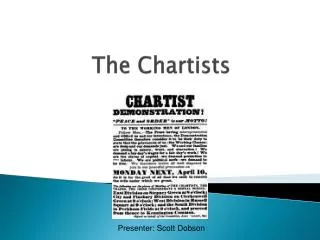
Kennington Common • O’Connor attempted ‘moral force’ tactics by arranging a petition and a big meeting • It was claimed there were over 5.7 million signatures on the petition, but inspection by parliament showed there were less than 2 million with many forgeries • Accused of destroying credibility of the movement
Did Chartism Fail? • Kennington Common fiasco damaged the movement, but pockets of strength remained- into the 1850s there were well attended meetings in London, Birmingham and Leicester • But, Chartist candidates did very badly at 1852 General Election and sales of the Northern Star dropped considerably • Tactics of mass mobilisation still impressive