Download
1 / 12
120 likes | 238 Views
This lecture delves into the fundamentals of mathematical reasoning, examining causal statements and logical paradoxes. It begins with simple examples such as "If I study hard, I will get a good grade," and progresses into complex paradoxes like Zeno's paradox of Achilles and the tortoise, and the barber's paradox. We analyze syllogisms, including major and minor premises, and deduce conclusions. The lecture emphasizes the importance of logical reasoning in mathematics and presents classical paradoxes illustrating the nuances of truth and contradiction.

E N D
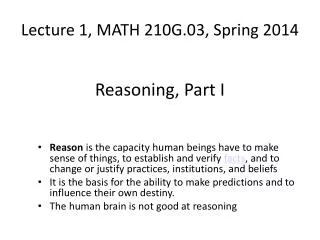
Lecture 1, MATH 210G.04, Spring 2011 Mathematical Reasoning, Part I
Causality • Ben is a dog. all dogs are green Ben is green.
Some questionable statements • If a=5 then 2*a =2*5 • All triangles have three sides • If I study hard I will get a good grade • If I major in math then I will get a better job than if I major in english. • If I take this pill then I will feel better. • If Sarah Palin is elected president then the world will end in 2012.
Logical paradoxes I: Zeno’s paradox of Achilles and the tortoise
That which is in locomotion must arrive at the half-way stage before it arrives at the goal. (Aristotle) • Achilles is in a footrace with the tortoise. • Achilles allows the tortoise a head start of 100 metres. • each racer starts runs at some constant speed • after some finite time, Achilles will have run 100 metres, • During this time, the tortoise has run 10 metres. • after some finite time, Achilles will have run 10 more metres, • During this time, the tortoise has run 1 more metre • ETC • Whenever Achilles reaches somewhere the tortoise has been, he still has farther to go. • There are an infinite number of points Achilles must reach where the tortoise has already been. • He can never overtake the tortoise.
The barber’s paradox • In a village, the barber shaves everyone who does not shave himself, but no one else. • The question that prompts the paradox is this: • Who shaves the barber?
The paradox of the liar • This sentence is false • liar paradox is attributed to Eubulides of Miletus in the 4th century BC.
Logical arguments I: The syllogism • Aristotle, Prior Analytics: a syllogism is "a discourse in which, certain things having been supposed, something different from the things supposed results of necessity because these things are so.”
Syllogism cont. • A categorical syllogism consists of three parts: the major premise, the minor premise and the conclusion. • Major premise: All men are mortal. • Minor premise: Socrates is a man. • Conclusion: Socrates is mortal. • Major premise: All mortals die. • Minor premise: All men are mortals. • Conclusion: All men die.
Modus ponens • If P, then Q. P. Therefore, Q • If Socrates is a man then Socrates is mortal • Socrates is a man • Socrates is mortal