Exploring Earth's Biomes: From Tundra to Tropical Rainforests
This overview highlights the diverse biomes on Earth, encompassing the Tundra, Taiga, Temperate Deciduous Forests, Tropical Rainforests, Deserts, Grasslands, and Aquatic Biomes. Each biome is characterized by its unique climate, vegetation, and animal life, revealing the intricate relationships among ecosystems. Information about human impacts, particularly in tropical rainforests and desert regions, is also addressed. Understanding these biomes is vital for appreciating the biosphere and promoting conservation efforts.


Exploring Earth's Biomes: From Tundra to Tropical Rainforests
E N D
Presentation Transcript
Biomes Kinsey Gates- 2nd period
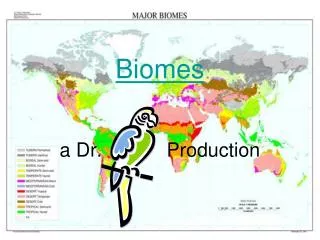
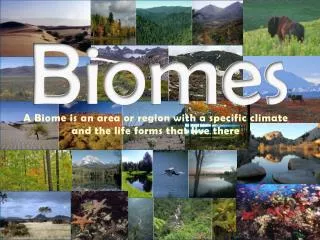
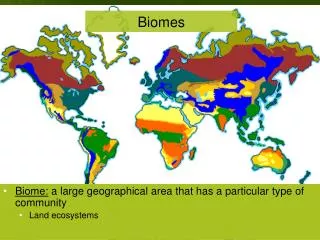
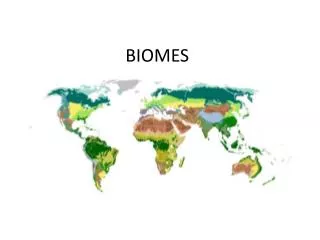
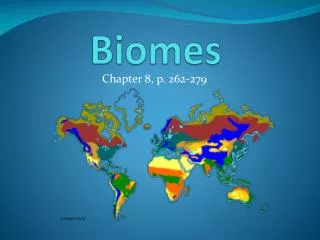
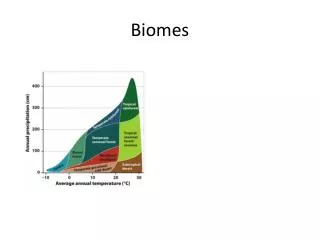
Biome • A large region characterized as having distinct climate (temperature and rain) with certain animals and plant life.
Tundra • Cold dry treeless region, permafrost, little precipitation, mostly ice and snow, Artic Circle, Northern Canada.
Biomes- Part of the Biosphere • Old (organism) • People (population) • Can’t (community) • Eat (ecosystem) • Bean (biome) • Burritos (biosphere) Levels of Organization
TAIGA • Cold, coniferous forest (evergreen trees), thaws in the summertime, Alaska, NW United States and Canada, mostly snow.
Temperate Deciduous Forest • A region with 4 distinct seasons, most of the United States area, varied trees and animal species. Rain, moderate temperature and a long growing season.
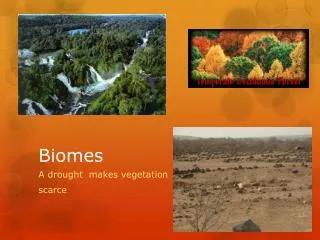
Tropical Rain Forest • Most biologically diverse, hot, humid, and rainy! Brazil, Central America. • Human impact: habitat being destroyed by loggers and farmers.
DESERT • Hot and dry, supports little plant life. Sahara Desert (Africa), Southwest U.S., parts of Mexico, and Asia.
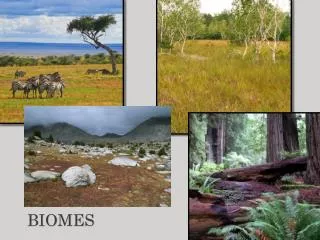
GRASSLANDS • Prairies, plains, and savannahs. Few trees, moderate rain and temperatures. Montana, Wyoming, Kansas, Nebraska, Africa, & Australia.
Aquatic Biomes • 2/3 of the Earth’s surface is covered by water! • Many species of animals and plants are adapted to live in fresh and salt water environments. LOOKS LIKE BLUE & WHITE ON THE GLOBE!
Lakes, rivers, ponds, and ice caps! FRESH WATER Dissolved 02
Ocean Water Oceans of the world H2O, 3% NaCl