Download
1 / 13
130 likes | 274 Views
Explore the fascinating world of minerals with an overview of their five essential properties and the two main types of tests used for identification. Learn about Moh’s Scale of Hardness, created by Friedrich Moh, which ranks minerals from the softness of talc to the hardness of diamond. Discover the characteristics of various minerals like gypsum, calcite, fluorite, and diamond, including their colors, streaks, and uses. This guide serves as an educational resource for identifying minerals based on physical properties and hardness.

E N D
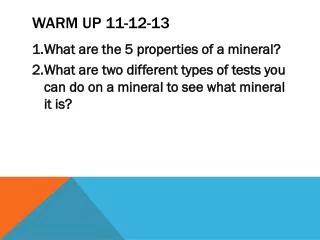
Warm Up 11-12-13 • What are the 5 properties of a mineral? • What are two different types of tests you can do on a mineral to see what mineral it is?
Moh’s Scale of Hardness Moh’s Scale of Hardness was made by a man named Friedrich Moh. It measures to see how much a mineral can be scratched. It goes from talc to diamond.
Talc • softest on Moh’s scale • light to dark green, brown, white • monoclinic or triclinic • fractures in an uneven way • Streak is white to pearl green • its luster is pearly or wax-like • can be used as talcum powder or baby powder.
Gypsum • number 2 on the scale of hardness • colorless to white; may be yellow, tan, blue, pink, brown, reddish brown or gray due to impurities • luster is vitreous to silky, pearly, or waxy • streak is white • prismatic • can be used as drywall
Calcite • colorless or white, also gray, yellow, green • conchoidal • number 3 on the scale • streak is white • trigonal hexagon scalenohedral • vitreous to pearly on cleavage surfaces
Fluorite • colorless, white, purple, blue, green, yellow, orange, red, pink, brown, bluish black; commonly zoned • isometric • subconchoidal to uneven • vitreous • number 4 on scale • streak is white
Apatite • transparent to translucent, usually green, less often colorless, yellow, blue to violet, pink, brown. • hexagonal • streak is white • conchoidal to uneven
Feldspar • pink, white, gray, brown • vitreous • streak is white • is number 6 on the scale • triclinic or monoclinic
Quartz • from colorless to black, through various colors • trigonal trapezohedral and hexagonal • vitreous – waxy to dull when massive • streak is white • number 7 in scale
Topaz • colorless (if no impurities), blue, brown, orange, gray, yellow, green, pink and reddish pink • Orthorhombic • vitreous • streak is white • number 8 on the scale
Corundum • colorless, gray, brown; pink to pigeon-blood-red, orange, yellow, green, blue to cornflower blue, violet; may be color zoned, asteriated mainly grey and brown • trigonal • number 9 on scale • vitreous • streak is white
Diamond!!!! • typically yellow, brown or gray to colorless. Less often blue, green, black, translucent white, pink, violet, orange, purple and red. • octahedral • hardest mineral • no color streak • the only thing that can scratch diamond is diamond • admantine