ACIDS and BASES
This guide provides a comprehensive overview of the properties and definitions of acids and bases, including taste, reactivity, and pH levels. It explores the Arrhenius and Bronsted-Lowry definitions, conjugate acid-base pairs, and the significance of strong and weak electrolytes. Key concepts such as percent ionization, polyprotic acids, and equilibrium calculations (Ka and Kb) are thoroughly discussed. This resource is valuable for students and educators seeking to deepen their understanding of acid-base chemistry.

ACIDS and BASES
E N D
Presentation Transcript
Properties of ACIDS • Sour to taste • React with some metals to form Hydrogen gas • Turn Litmus RED • Phenolphthalein stays colorless • Electrolytes (conduct) • Form H+ (H3O+ when attached to water molecules)
Properties of BASES • Bitter to taste • Slippery to touch • Turn Litmus BLUE • Phenolphthalein turns MAGENTA • Electrolytes • Many form OH- in water
Definitions of Acids and Bases • Arrhenius (traditional) • Acids: produce H3O+ in water • Bases: produce OH- in water • Examples • HCl(g) → H+(aq) + Cl-(aq) • NaOH (s) → OH-(aq) + Na+(aq) • Most common definition
Definitions of Acids and Bases • Bronsted-Lowry • Acids: H+ donor (proton donor) • Bases: H+ acceptor (proton acceptor) • Examples • HCl→ Cl- (donates H+) • NH3 → NH4+ (accepts H+)
Bronsted-Lowry cont. • When acids and bases donate or accept hydrogen ions, conjugate acids and bases are formed. • Conjugate Acid: particle formed when a Base gains a H+ • Conjugate Base: particle formed when an Acid donates a H+
Bronsted-Lowry cont. • Conjugate acid-base pair: two substances related by the loss or gain of a single H+ • Always paired with an acid and base • Examples- Label acid/base and conjugate acid/base • NH3 + H2O→ NH4+ + OH- • HCl+ H2O→ H3O+ + Cl- • Hint: Acid/Base is always Reactant; Conjugate Acid/Base is always Product
Terms • Amphoteric substances can behave as acids or bases (water) • Monoprotic acids donate only one H+ • Ex. HCl, HNO3 • Polyprotic acids donate more than one H+ • H2SO4, H2CO3
Relative Strengths of Acids and Bases • The stronger the acid, the weaker the conjugate base. • H+ is the strongest acid that can exist in equilibrium in aqueous solution. • OH- is the strongest base that can exist in equilibrium in aqueous solution.
Conjugate Acids and Bases • Any acid or base that is stronger than H+ or OH- simply reacts stoichiometrically to produce H+ and OH-. • The conjugate base of a strong acid (e.g. Cl-) has negligible acid-base properties. • Similarly, the conjugate acid of a strong base has negligible acid-base properties.
Acid-Base Equilibria • In pure water, the following equilibrium is established: • This is referred to as the autoionization of water.
Types of Acids and Bases • Weak acids and bases • Weak electrolytes • Partially ionize in water (much less than 100%) • Establish equilibria • Weak Acids • H3PO4, HC2H3O2, H2CO3 • Weak Bases • NH3, low [OH-]
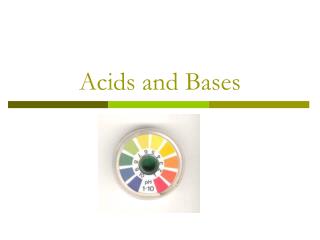
pH • Pouvoirhydrogene: “Hydrogen Power” • Measure of the acidity of a solution • Uses [H3O+] or [H+] • Concentrations usually expressed as powers of 10 • pH = -log [H+] • pH scale 0-7 acid, 7 neutral, 7-14 base • Can be lower than 0 or higher than 14
pOH • “Hydroxide Power” • Measures alkalinity of a solution • Uses [OH-] • pOH = -log [OH-] • pOH scale 0-7 base, 7 neutral, 7-14 acid • Can be lower than 0 or higher than 14 • pH + pOH = 14 • From the autoionization of water
Calculating Ka from pH • Weak acids are simply equilibrium calculations. • The pH gives the equilibrium concentration of H+. • Using Ka, the concentration of H+ (and hence the pH) can be calculated. • Write the balanced chemical equation clearly showing the equilibrium. • Write the equilibrium expression. Find the value for Ka. • Write down the initial and equilibrium concentrations for everything except pure water. We usually assume that the change in concentration of H+ is x. • Substitute into the equilibrium constant expression and solve. Remember to turn x into pH if necessary
Percent ionization is another method to assess acid strength. • For the reaction
Percent ionization relates the equilibrium H+ concentration, [H+]eq, to the initial HA concentration, [HA]0. • The higher percent ionization, the stronger the acid. • Percent ionization of a weak acid decreases as the molarity of the solution increases.
Polyprotic acids • Polyprotic acids have more than one ionizable proton. • The protons are removed in steps not all at once: • It is always easier to remove the first proton in a polyprotic acid than the second. • Therefore, Ka1 > Ka2 > Ka3 etc.
Relationship between Ka and Kb • For a conjugate acid-base pair • Therefore, the larger the Ka, the smaller the Kb. That is, the stronger the acid, the weaker the conjugate base. • Taking negative logarithms:
Strong Acids and Bases • Strong electrolytes • Ionize (separate) 100% in water • Strong Acids: HCl, HNO3, H2SO4, HClO3, HClO4, HI, HBr • Usually only source of H+, so pH can be calculated from the molarity of the acid (unless < 10-6) • Strong Bases: NaOH, KOH, Ca(OH)2 • Most Group 1 and 2 metal hydroxides are strong bases • Ionic metal oxides, hydrides, and nitrides
Salt Solutions • Most salts are strong electrolytes (ionize in solution) • Acid-Base properties result from their ions. • Many ions react with water to form H+ and OH- (hydrolysis) • Anions from weak acids are basic. • Anions from strong acids are neutral. • All cations (except alkali/alkaline earth metals) are weak acids
Salt Solutions • SA + SB = Neutral Salt • SA + WB = Acidic Salt • WA + SB = Basic Salt • WA + WB = Acidic or Basic Salt • Based on relative strength of Ka and Kb • Ka > Kb = acidic • Ka < Kb = basic
Acid-Base Behavior and Chemical Structure • For compound H-X, • If H is partially positive, then it is an acid • If H is partially negative, then it is a base • Bond Strength and Polarity affects acid/base strength • Bond strength used to determine strength in a group; Bond polarity used to determine strength in a period • Acid strength tends to increase down a group; Base strength tends to decrease down a group • Acid strength tends to increase L to R; Base strength tends to decrease L to R
Oxyacids • Acids that contain OH groups bound to the central atom ( Y – O – H) • Strength depends on Y and the atoms attached to Y • Increasing electronegativity of Y = increasing acidity • Increasing the number of O atoms attached to Y increases polarity, which increases strength • Ex. HClO < HClO2 < HClO3 < HClO4
Carboxylic Acids • Contain –COOH • Additional oxygen atom on the carboxyl group increase the polarity of the O-H bond and stabilizes the conjugate base
Lewis Acids and Bases • Lewis Acid – electron pair acceptor • Lewis Base – electron pair donor • Do not need to contain protons – most general definition of acids/bases • Many Lewis acids have an incomplete octet (BF3) • Transition metal ions are usually Lewis acids • Lewis acids must have an empty orbital • Compounds with multiple bonds can be Lewis acids
Amino Acids • Amphoteric • Contains carboxyl group (acid) and ammine group (basic) • Proton of the carboxyl group is transferred to the basic nitrogen of the ammine • Results in a zwitterion or dipolar ion