Download
1 / 20
200 likes | 325 Views
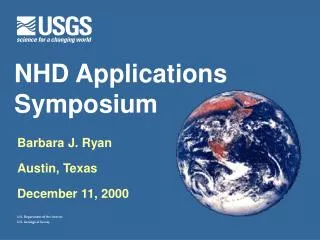
The U.S. Geological Survey's Innovative Symposium held on December 11, 2000, in Austin, Texas, focused on the integration of natural science data to tackle pressing environmental issues. Highlights included discussions on hazards mitigation, species habitat loss, water sustainability, and real-time data sharing for enhanced decision-making. Featuring a comprehensive framework for users to access biodiversity information and resource assessments, the Gateway to the Earth initiative fosters cooperative partnerships across federal, state, and local agencies, universities, and the private sector, enabling society to address integrated scientific challenges effectively.

E N D
NHD Applications Symposium Barbara J. Ryan Austin, Texas December 11, 2000 U.S. Department of the Interior U.S. Geological Survey
Integrated Information Environmental Issues Facing Society Hazards Mitigation Species and Habitat Loss Land and Water Sustainability Coastal Habitat Loss River Management Nonrenewable Resource Supply Environmental Change Land and Water Restoration
Gateway to the Earth • Definition • a coherent set of interfaces that enables diverse users to find, get, and use natural science information in ways that are meaningful to them.
Integrated Taxonomic Information System Fish and Wildlife Disease Studies Migratory Bird Distribution Mapping GAP Analysis Biodiversity Information National Standards: Products Derived from Classified Data National Biological Information Infrastructure National Spatial Data Infrastructure Land Use History and Analysis Decision Support Systems Biologic Information Global Change Research Amphibian Deformity/ Decline Studies
Real-time Earthquake Data Mineral and Energy Resource Assessments Coastal Information National Standards: Products Derived from Classified Data National Spatial Data Infrastructure Seismic Hazard Maps Geologic Maps Geologic Information National Geologic Map Database Landslide Hazard Assessments Volcanic Hazards
Ground and Surface Water Studies Real-time Water Data National Standards: Products Derived from Classified Data National Spatial Data Infrastructure Sediment Hydrologic Information Water Quality Models National Water Information System Water Quality Data Streamflow Drought
National Standards: Products Derived from Classified Data Geographic Names Information System (GNIS) National Spatial Data Infrastructure Land Cover Characterization Satellite Imagery Aerial Photography Ortho Imagery Maps Elevation Vectors Raster Graphics Geographic Information National Atlas of the U.S.
Access should be interactive... Click Here Click Here Click Here
Geographic Information Biologic Information N S D I Clearinghouse Hydrologic Information Geologic Information Information by Organization
Biologic Information Geographic Information N S D I clearinghouse Hydrologic Information Geologic Information USGS Gateway to the Earth
Enable Interactive Access by: • Geography-- Place, Ecoregion, Physiography, Stream/Watershed, Latitude/ Longitude, Congressional District • Discipline -- Biologic, Geographic, Geologic, Hydrologic • Theme-- Hazards, Resources, Environment • Organization-- Science Center, District Office, Science Team, Mapping Center, Field Office • Time- Date, Time Series
Information Architecture Logical physical or virtual grouping of like information promotes less redundancy, more efficient navigation, and more meaningful cross-linkages: Logical physical or virtual grouping of like information promotes less redundancy, more efficient navigation, and more meaningful cross-linkages:
Cooperative Partnerships • Federal Agencies • State and Local Governments • Universities • Private Sector Companies
Gateway to the EarthBenefits and Outcomes • Enabling structure so ANYONE can find what they need in order to: • Solve integrated, relevant scientific problems • Make decisions • Educate and learn • Reach new audiences • Use earth and natural science information in ways we have not envisioned
NHD as a prototype of Gateway • Provides a foundation for interaction • add or attach geographic details and attributes • reference source for registering and compiling data • reference map for displaying locations and results of analysis • tools to make the wealth of NHD-linked information available through Gateway
NHD’s Success • 63,000 watersheds have been downloaded since data was made available early this year
NHD’s Use • watershed assessment • mapping fish species distributions • 5th and 6th level HUC delineation for the state • land management related to mining projects • endangered species critical habitat mapping • to go fishing !
NHD’s Champions • Keven Roth – USGS Lead • Tommy Dewald – EPA Lead • Bob Pierce – HUCs and Workshop Coordination
Gateway to the Earth... Opens Natural Science to the World