Download
1 / 10
100 likes | 227 Views
The Scientific Revolution marked a pivotal shift in human understanding of the universe, challenging classical views derived from Aristotle, Ptolemy, and Plato. Key figures such as Copernicus, Galileo, and Newton advanced new theories, emphasizing mathematical principles and empirical methods. The transition from geocentric to heliocentric models, Kepler's elliptical orbits, and the experimental method transformed scientific inquiry. This era fostered the establishment of the scientific community and laid the groundwork for modern scientific methods, forever altering humanity's relationship with nature.

E N D
The Aristotelian Universe Derived from Ptolemy, Aristotle, and Plato Classical Writings “Christianized” Medieval Cosmology Alchemy
Causes of the Scientific Revolution Intellectual life and universities Renewed emphasis on mathematics Renaissance system of patronage Navigational problems of long sea voyages Better scientific instruments
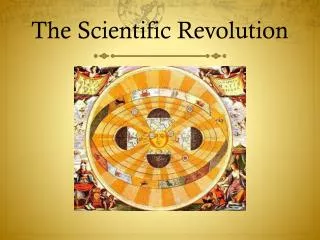
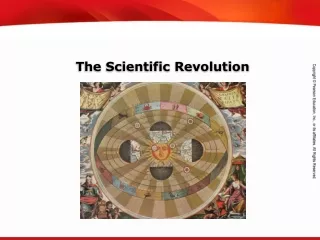
Copernicus (1473-1543) Sun-centered universe Challenged circular orbits Universe of staggering size Earth no different than any other planet
Francis Bacon (1561-1626) Father of the Scientific Revolution The Inductive Method
Rene Descartes (1596-1650) The Deductive Method Father of “analytical geometry”
Johannes Kepler (1571-1630) Planetary motion conforms to mathematical formula Elliptical orbits Planets do not move at uniform speeds in their orbits
Galileo Galilei (1564-1642) Experimental method Mathematical formula for acceleration of falling objects Law of inertia Discoveries using the telescope
Isaac Newton (1642-1727) Blends inductive and deductive methods Argues for a universe governed by natural laws Stud
Consequences of the Scientific Revolution Rise of the “Scientific Community” Royal Society of London (1662) Academy of Royal Sciences (1666) The modern scientific method A universe ordered according to natural laws