Download
1 / 34
340 likes | 462 Views
The respiratory system is vital for gas exchange between the atmosphere, lungs, blood, and tissues. It includes pulmonary ventilation (breathing), external respiration (in the lungs), gas transport via blood, and internal respiration (within tissues). Key structures include the nose, pharynx, larynx, trachea, bronchial tree, and lungs, each playing a unique role in respiration. Essential requirements for effective gas exchange include thin, moist surfaces with a large area relative to the organism's size. This overview explains the functional anatomy and processes involved in respiration.

E N D
RESPIRATION The exchange of gases between the atmosphere, lungs, blood, and tissues
Respiration • Pulmonary ventilation: “breathing” • External respiration: occurs within the lungs • Transport of respiratory gases: via the blood • Internal respiration: occurs within the tissues
REQUIREMENTS • Gas exchange surfaces must be thin. • Gas exchange surfaces must remain moist. • Gas exchange surfaces must be large in relation to the size of the organism.
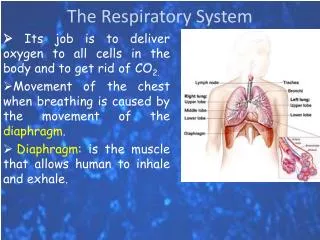
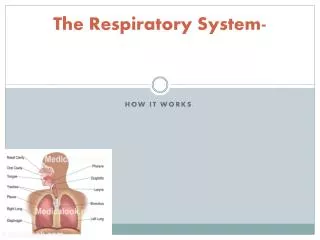
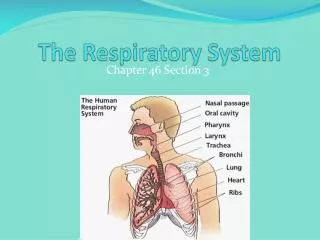
FUNCTIONAL ANATOMY - Upper respiratory • Nose • Pharynx - Lower respiratory • Larynx • Trachea • Bronchial tree • Lungs • Diaphragm
Features of the Nose • External Nares: • The nostrils where air enters the nasal cavity • Nasal Septum: • Divides the nasal cavity into two symmetrical halves • Olfactory/Respiratory Mucosa: • Contain smell receptors and goblet cells for mucus secretion
Features of the Pharynx • Nasopharynx: • Acts only as an air passageway; when swallowing, uvula and soft palate close it off • Location of pharyngeal tonsil • Eustachian tubes • Oropharynx: (fauces) • Common passageway for food and air • Location of palatine and lingual tonsils • Laryngopharynx: (hypopharynx) • Common passageway for food and air • Intersects with trachea; location of epiglottis
Features of the Larynx • Three functions • Provides an open airway • Routes food and air into proper tubes (epiglottis) • Voice production (vocal folds) • Several cartilages located here (thyroid, cricoid, and arytenoid) • Epiglottis: • Flap of elastic cartilage that shuts off larynx and trachea from incoming food (only works in conscious people) • Vocal Folds: • True vocal cords that vibrate with air coming up from the lungs. Space between is called the rima glottidis • Vestibular folds (false vocal cords)
Features of the Trachea • Contains mucosa • Goblet cells produce mucus • Cilia of pseudostratified columnar epithelium propel debris-laden mucus to pharynx • Contains C-shaped cartilage • Helps the trachea to expand and recoil • Prevents trachea from collapsing despite pressure changes that occur during breathing
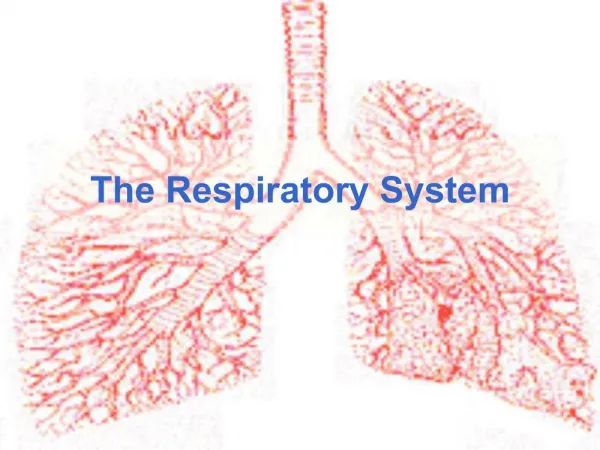
Features of the Bronchial Tree • Primary Bronchi: • Runs obliquely into mediastinum and enters lung at lung hilus; two primary bronchi emerge from trachea. Right bronchi is larger, shorter and oblique. Aspiration. Bifurcation is called the carina. • Secondary Bronchi: • Each primary divides into secondary (3 on right and 2 on left) bronchi that service each lung • Tertiary Bronchi: • Secondary bronchi branch into tertiary which branch into smaller and smaller tubes • Bronchioles: • Tiniest of tertiary bronchi, less than 0.5 mm in diameter; smallest are terminal bronchi
Bronchoscope: illuminated, tubular instrument to view bronchi and trachea. • Bronchography: technique used to examine the bronchial tree. A catheter (intratracheal) is passed through the nose or mouth and through the rima glottidis into the trachea. A contrast, usually containing iodine, is inhaled and an x-ray is taken called a bronchogram.
Features of the Lower Bronchial Tree • Terminal Bronchioles: • The smallest bronchioles that feed directly into: • Respiratory Bronchioles: • Feed into each lung which lead into: • Alveolar ducts: • Contain rings of smooth muscle and alveoli which is the structure gases are exchanged in. • Contain a chemical called surfactant which reduces surface tension
Lungs - right and left - Lungs have lobes and fissures - 3 lobes in the rt. lung - superior - middle - inferior - 2 fissures: horizontal and oblique - 2 in the left lung - superior - inferior - cardiac notch for heart to rest in. - 1 fissure: oblique
- Lung has broad inferior surface called the base. - Lung has a pointed superior surface called the apex or the cupola