Exploring Gas Exchange: The Effects of CO2 on pH Levels in Water and Blood
This experiment investigates the relationship between exhaled carbon dioxide (CO2) and pH changes in water. By using a straw to exhale into a tube of water, participants can observe the effects of CO2 on acidity through the pH indicator Bromothymol Blue. The observations may vary among individuals due to differences in respiratory function and health. This experiment also connects to cellular respiration, emphasizing the balance of oxygen and carbon dioxide in the blood, particularly in conditions like COPD, highlighting the importance of maintaining proper pH levels in the body.

Exploring Gas Exchange: The Effects of CO2 on pH Levels in Water and Blood
E N D
Presentation Transcript
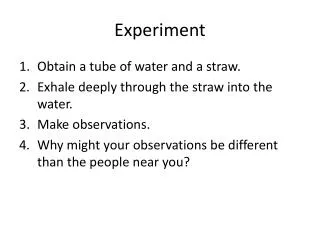
Experiment • Obtain a tube of water and a straw. • Exhale deeply through the straw into the water. • Make observations. • Why might your observations be different than the people near you?
pH IndicatorBromothymol Blue acidic basic
pH scalepH = -log [H+] a [H+]=1•10-1 [H+]=1•10-14 http://cwx.prenhall.com/bookbind/pubbooks/hillchem3/medialib/media_portfolio/15.html
Example pH = -log [H+] What would be the pH of 0.01M solution of HCl (like your stomach acid)? pH = -log [H+] pH = - -2 pH = 2
Cellular Respiration (Glucose )C6H12O6 + 6O2 6CO2 + 6H2O
Chromatin Nuclear envelope Nucleus Nucleolus Plasma membrane Smooth endoplasmic reticulum Cytosol Lysosome Mitochondrion Centrioles Rough endoplasmic reticulum Centrosome matrix Ribosomes Golgi apparatus Microvilli Secretion being released from cell by exocytosis Microfilament Microtubule Intermediate filaments Peroxisome Figure 3.2
What happens to CO2 in blood? What happens to CO2 in water? CO2 + H2O HCO3- + H+ Carbonic Anhydrase CO2 + H2O HCO3- + H+
CO2 + H2O HCO3- + H+ CO2 + H2O HCO3- + H+ High pH in body CO2 Low pH
COPD • High blood CO2 , low blood O2 but normal breathing rate. • Blood O2 a little low so breath in O2 by O2 tank. • This can increase blood O2 but it slows down breathing rate. • This leads to increase blood CO2 , and decrease in pH (acidic). BALANCE of blood O2 and blood CO2 / pH