Download
1 / 8
80 likes | 210 Views
Explore the fascinating process of science, as illustrated through whimsical examples like weighing a witch against a duck. This guide delves into the scientific method, outlining its steps and significance in studying the natural world. Learn about hypotheses, experiments, independent and dependent variables, and how to form predictions. Through humorous anecdotes, including characters testing theories from productivity juice to guppy populations, discover how science guides our understanding of the universe and offers a structured approach to inquiry.

E N D
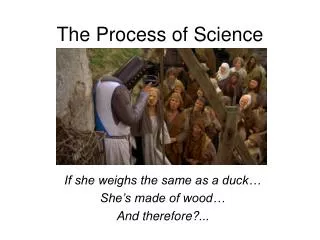
The Process of Science If she weighs the same as a duck… She’s made of wood… And therefore?...
SHE’S A WITCH!!! • Need an organized way of using evidence to learn about the natural world. • Many ways of going about this…
The Scientific Method • A formal process of inquiry that consists of a series of steps. • Does not always adhere to this protocol.
Hypothesis • A proposed scientific explanation for a set of observations. • Uses “deductive reasoning” • General Specific • Maples are trees Maples have leaves!!! • Trees have leaves • Tested by an “controlled experiment” • Independent Variable – the one variable that is deliberately changed • Dependent Variable – the variable that is observed and that changes in response to the dependent variable • Written as an “If…then” statement…
HYPOTHESIS: • If the flashlight’s batteries are dead. • EXPERIMENT: • and I replace the batteries with new ones, • PREDICTED RESULTS: • then the flashlight will work.
Practice • Smithers thinks that a special juice will increase the productivity of workers. • Homer notices that his shower is covered in a strange green slime. Barney tells him that coconut juice will get rid of the green slime. • Bart believes that mice exposed to microwaves will become extra strong (maybe he’s been reading too much Radioactive Man). • Krusty was told that a certain itching powder was the newest best thing on the market, it even claims to cause 50% longer lasting itches.
Case Study: The affects of selective predation on the life history of guppy populations