Download
1 / 25
250 likes | 355 Views
This report evaluates commercially available passive samplers for monitoring pollutants in Wilmington, CA, focusing on air quality and environmental justice. The study employs various sampling methods to identify chemical compounds like NOx, H2S, and volatile organic compounds in urban environments. Three main tasks include chamber evaluations, pilot studies, and harbor communities monitoring to enhance understanding of pollutant saturation across different conditions. The findings indicate that Ogawa and Radiello passive samplers are precise and sensitive, essential for fostering healthier communities.

E N D
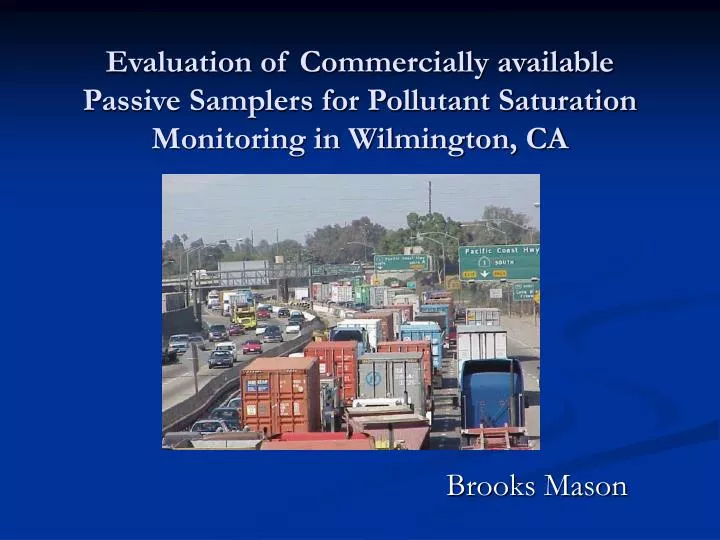
Evaluation of Commercially available Passive Samplers for Pollutant Saturation Monitoring in Wilmington, CA Brooks Mason
Overview • What is passive sampling? • Commercial Passive Sampling Media • Environmental Justice Project • Task I- Chamber Evaluations • Task II- Pilot Study • Task III- Harbor Communities Monitoring Study
What is Passive Sampling? • Collection of various chemical compounds utilizing adsorbents • Chemical adsorbents • Physical adsorbents • Virtually maintenance free • Requires no pumps, moving parts, electricity, maintenance
Passive Sampling Cont. • Time integrated measurement • High Sensitivity • Poor Resolution • Relies on an experimentally calculated sampling rate
Ogawa & Company Passive Sampler • Symmetrical Design allows for two simultaneous measurements • Utilizes chemical adsorbent Pads for the collection of NOx, NO2, and SO2 • Triethanol Amine • Sampling Rate is Temperature and Humidity Dependent
Radiello Passive Sampler • Utilizes a cylindrical diffusive body to increase surface area, sampling rate • Aldehydes • DNPH • Hydrogen Sulfide • Zinc Acetate • VOC • Carbograph 4
Importance of Chemical Species • Aromatics, 1,3-butadiene, and Aldehydes react with NOx to produce Ozone and are hazardous to human and ecosystem health • SO2 emissions produce secondary aerosols and contribute to ecosystem acidity • H2S is hazardous to human health and produces a foul odor
Environmental Justice ProjectEric Fujita, PI; Barbara Zielinska, Co-PI; Dave Campbell • Task I (3/06-11/06) • Evaluate Passive monitors for NOx, H2S, BTEX, 1,3-butadiene, formaldehyde, acetaldehyde, acrolein in a controlled atmospheric chamber • Task II (8/06) • Evaluate Passive monitors for NOx, H2S, BTEX, 1,3-butadiene, formaldehyde, acetaldehyde, acrolein in the study area (Wilmington, CA) • Task III (2/07-11/07) • Harbor Communities Monitoring Study • 25 Sites • Other measurements include minivol particulate sampling, photoaccousitic black carbon analyzers, dusttrak, qtrak, PID, basic meteorological, quality assurance
Task I - exp Aldehyde Samplers Sampling Ports Fan Temp/RH
Task I - exp • Chamber Exposure Information • 7 Day Exposures • Nominal Concentration based on Wilmington Average
Task I Results *Acrolein Validation Method highly inaccurate *VOC data is forthcoming due to 1,3 butadiene
Task II exp • Task II Study Site • North Long Beach AQMD Station • August 2006 • Objectives • Evaluate Replicate Precision and Accuracy of Passive Samplers under actual Environmental Conditions • Evaluate effect of stagnant nightime air on sampling rate
Passive Measurement Ogawa NOx Ogawa SO2 Radiello H2S Radiello VOC Radiello Aldehyde Validation Method AQMD NOx Box AQMD Continuous SO2 N/A (7) 24 hour Canisters (7) 24 hour DNPH Task II exp
Task III exp • Harbor Communities Monitoring Study • 4 seasonal saturation monitoring campaigns for 1 month each, 2007 • Winter 2/13/07 – 3/13/07 finished • 23 sites measure NOx, SO2, VOC, and Aldehyde • 6 sites for measurement of NO2 • 3 sites for measurement of H2S • 1 QA site with triplicate passive measurements and validation measurements
DRI Core DRI Core + continuous DRI Passive only Res1 SCAQMD (tentative) Port of Los Angeles OCN Port of Long Beach FD13 Res2 HES Res4 Res3 Revised 1/16/07 W710 Res6 E710 Res5 Res7 BFL E110 SE Res8 RES9 Res10 FD49 AQMD Res11 Note: DRI’s sampling locations are preliminary and are subject to change. PLAB
Conclusions • Radiello and Ogawa passive samplers have shown throughout all experiments to be precise, accurate, and sensitive. • Low wind speeds have little effect on the sampling rate for all sampler types • Future work • Identify sampling rate for 1,3-butadiene in chamber exposures • Identify effect of storage time on recovery • Develop a method for passive collection of aldehydes using PFPH with analysis by thermal desorption GC/MS
Acknowledgements • California Air Resources Board • Thanks to Barbara Zielinska, Eric Fujita, Dave Campbell, Larry Sheetz, Katy Rempala, Anna Cunningham, Mark McDaniel, and Mike Keith • Questions?