Elements make compounds
This educational resource explores the fundamental concepts of chemistry, focusing on elements, compounds, and exothermic reactions. Through an engaging experiment with magnesium and oxygen, students learn how energy is released as light during combustion, resulting in the formation of a new, heavier substance, magnesium oxide. The presentation also covers the naming of compounds, including the use of suffixes like -ide, -ite, and -ate, to help students grasp the structure and naming conventions within chemical compounds. Perfect for enhancing science lessons and promoting interactive learning.

Elements make compounds
E N D
Presentation Transcript
Elements make compounds Substances Miss Doig
Explosive experiment • Goggles, bench mat, tongs, bunsen, lighter and magnesium. • CAREFULLY put magnesium in flame.
Making a compound • What energy is being released? • When magnesium is burned, energy is released as light. • Is there a new substance being formed? • A new substance forms, it is white. • Is this new substance lighter or heavier? • -This new substance is heavier as there are two different elements in the substance, they are magnesium and oxygen.
Elements make compounds • When elements join to make a compound, energy is released and a new substance is formed. • A word which means ‘energy released’ is exothermic. • What do you think endothermic means?
Naming Compounds Substances
Elements and symbols that you should know: • Oxygen • Fluorine • Neon • Magnesium • Aluminium • Silicon • Phosphorus O F Ne Mg Al Si P • Hydrogen • Helium • Lithium • Beryllium • Boron • Carbon • Nitrogen H He Li Be B C N
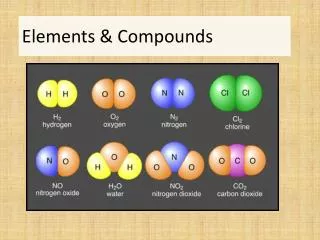
This happens with the following elements: • H2 • N2 • O2 These elements always go around in pairs. For example, hydrogen looks like this: If two identical elements combine then the name doesn’t change. .e.g. oxygen + oxygen oxygen
Sodium + chlorine • Magnesium + fluorine When two elements join the name ends with ____ide e.g. Magnesium + oxygen magnesium oxide
When three or more elements combine and one of them is oxygen the ending is _____ite or ________ate e.g. Copper + sulphur + oxygen Copper sulphate • Calcium + carbon + oxygen • Potassium + carbon + oxygen • Sodium + sulphur + oxygen
This powerpoint was kindly donated to www.worldofteaching.com http://www.worldofteaching.com is home to over a thousand powerpoints submitted by teachers. This is a completely free site and requires no registration. Please visit and I hope it will help in your teaching.