Elements and Compounds: Properties and Classifications
400 likes | 459 Views
Explore the unique characteristics and classifications of elements and compounds, including properties, behavior, and ways to differentiate them. Learn about metals, nonmetals, metalloids, and chemical formulas.


Elements and Compounds: Properties and Classifications
E N D
Presentation Transcript
Elements and Compounds Mod.H U.1 L.4
Pure substances • Have only one type of particle • Same composition throughout
2 groups: • Elements • Compounds
Elements • Cannot be separated by physical or chemical means • 92 elements (naturally occurring) • Classified by properties
Unique Characteristic Properties of Elements • Melting point, Boiling point • Density, • Conductivity (heat and electricity) • Reactivity, etc
Look @ Fig.3 p83Can you tell the 3 elements apart using… • 1. density?
What about … • 2. Conductivity? • 3. Reactivity? • 4. Melting Point?
A Substance is identified by • A set of properties • not any one single property
Three groups of elements have shared properties: • Metals (most elements) • Nonmetals • Metalloids
Metals … • Shiny • Good conductors • Malleable • Ductile • Have high melting & boiling points
Examples of metals • Found on the left side of the Periodic Table • Most are solids except for Hg
Nonmetals • Dull • Poor conductors • Brittle, unmalleable, not ductile • Lower Melting and Boiling points, Densities.
Metalloids • Only 7 of them • Show properties of both metals and nonmetals: • some shiny, some dull; • somewhat malleable, ductile, etc. • Semi-conductors
The Metalloids • Boron • Germanium • Silicon • Arsenic • Antimony • Tellerium • Polonium
QuizIdentify group(s) of elements that have following properties:metals, nonmetals or metalloids • Good conductors of electricity • Brittle and unmalleable • Shiny • Poor conductors of thermal energy or insulators
Review • What is a pure substance? • You found a piece of solid that was shiny, had a high melting point of about 1,000 ’C and flattened when you hit it with a hammer. Could this substance be a nonmetal or a metal? How can you tell?
Assignment: • Use a Periodic Table pR12-13 to fill in this table in your notebook: Fill in the first 20 elements then add the ff 16 more …
Iron, Cobalt, Nickel, Copper, Zinc, Silver, Tin, Gold, Lead, Mercury, Iodine, Bromine, Lanthanum, Actinium, Titanium & Uranuim
Mini-project • Create Flashcards of each element • Get a ring or Ziploc bag or Make a booklet • http://periodictable.com/ Element Chemical symbol Atomic Number State at R.T. Metal/Nonmetal/Metalloid?
The Updated Periodic Table - 2018 Visit • http://periodictable.com/ and • https://www.nist.gov/sites/default/files/documents/2018/08/29/nist_periodictable_july2018_crop.pdf
Section 4-2Compounds The 2nd type of pure substance
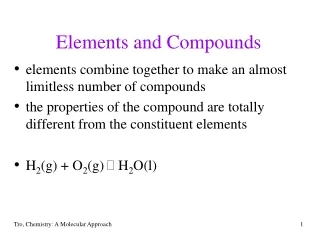
Two or more elements chemically combined • Atoms combine in specific ratios • They CAN be broken down by chemical means • (Water into hydrogen and oxygen)
Compounds to know • (out of nearly 4 million kinds) • Table salt, water, carbon dioxide, glucose, baking soda (FORMULAS?) NaCl H2O CO2 C6H12O6 NaHCO3
A Chemical Formula • Symbols used to identify elements present • Tells ratio of element atoms present • Is constant for a particular compound
Chemical Formulas: • H2O H2O2 2 : 1 2 : 2 • CO2 H2SO4 1 : 2 2 : 1 : 4
Mass Ratio is constant • Hydrogen + Oxygen Water 2g : 16g 18g 1g : 8g Ratio: 1:8
Mg + O MgO 12g : 8g Ratio- 3:2 • CAN be broken down by chemical means e.g.(Water into hydrogen and oxygen)
Properties: • Each compound has its own unique set • Physical Properties … • Chemical properties … • Different from the elements that formed it e.g. O, H : colorless, odorless gases H2O : liquid. Na -metal, Cl -green gas, poisonous Sodium chloride- salt, colorless, essential for health.
EXAMPLES OF Methods of Chemical break-down • HEAT • COMBUSTION – BURNING • ELECTROLYSIS
Law of Conservation of Matter • Matter is neither created nor destroyed; It only changes from one form to another
Compds are classified by: • Their pH – How acidic or basic they are • If Organic (Carbon-containing) or Inorganic • The role they play - Proteins – enzymes, structural - Carbohydrates - Lipids – fats & oils - Nucleic acids
For more info… • Visit this photogallery of the elements http://chemistry.about.com/od/periodictableelements/ig/Element-Photo-Gallery.--98/