Frequency Distribution
Frequency distribution organizes data into classes with counts of observations in each class. Key characteristics include class limits (smallest and largest values), boundaries (values that separate classes), intervals (distance between boundaries), and midpoints (arithmetic mean of class boundaries). Steps to construct a frequency distribution involve ordering data, computing the range, dividing into intervals, and counting observations in each class. It's essential to follow rules, such as all-inclusive and mutually exclusive classes, to ensure accurate representation of data. Concepts such as sample mean, median, mode, variance, and standard deviation are also integral to frequency distribution analysis.

Frequency Distribution
E N D
Presentation Transcript
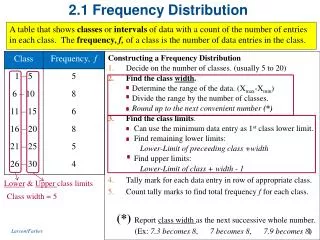
Frequency Distribution A Frequency Distribution organizes data into classes, or categories, with a count of the number of observations that fall into each class.
Characteristics of Classes • Class Limits; • smallest and largest observed values that can belong to a class • Boundaries; • actual values that separate successive classes • Intervals; • the distance spanned by the boundaries of a class • Class Midpoint • the arithmetic mean of its class boundaries
Steps for Constructing a Frequency Distribution • Array the data values in order by size from lowest to highest (or vice versa); • Compute the range; • Divide the range into a convenient number of class intervals of equal size; • Count the number of observations in each class to determine the total frequency; and • Display the class intervals with their frequencies.
Select a class interval that allows from 6 to 15 classes. Too many classes can destroy the summary effect of the grouping; too few classes can produce oversimplification of the data and result in inaccuracies from subsequent calculations. The number of classes, k, should be the smallest integer such that 2k> n, where n is the number of observations. How to Select a Class Interval?Some Rules of Thumb!
The All-Inclusive Rule: classes must be All-Inclusive. All-inclusive classes are classes that together contain all the data. The Mutually-Exclusive Rule: classes must be mutually exclusive. Classes must be arranged such that every piece of data can be placed in only one class. The Two Firm Rules in Grouping Data:
Class Midpoint Each class has a lower limit and an upper limit. Class midpoint, Mi, is the arithmetic mean of the two limits. Mi = (lower limit + upper limit) / 2
Sample Mean The sample mean of grouped data is: where, fi is the frequency of the ith class, and Mi is the midpoint of the ith class.
Sample Median The sample median of grouped data is: Med = L + ( n1 / n2 ) i where, L is the lower limit of the median class, n1 is the number of data values in the median class that lie below the median position, n2 is the number of observations in the median class, and i is class interval.
Sample Mode Sample Mode is the midpoint of the class having the greatest frequency.
Sample Variance Sample Variance is:
Sample Standard Deviation Sample Standard Deviation is: s = SQRT( Variance )