Download
1 / 13
130 likes | 231 Views
This paper discusses the production of prompt photons in electron-proton collisions at HERA, focusing on photon identification methods, inclusive prompt photons, and their association with jets. It highlights how these measurements can test Quantum Chromodynamics (QCD) by analyzing soft and hard processes. The study compares results with various event generators like PYTHIA and HERWIG, addressing normalization discrepancies and the influence of multiple interactions. The findings from the data analyses provide significant insights into the structure and dynamics of photons in high-energy particle collisions.

E N D
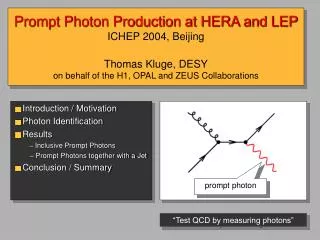
Prompt Photon Production at HERA and LEPICHEP 2004, BeijingThomas Kluge, DESYon behalf of the H1, OPAL and ZEUS Collaborations Introduction / Motivation Photon Identification Results Inclusive Prompt Photons Prompt Photons together with a Jet Conclusion / Summary prompt photon “Test QCD by measuring photons”
soft QCD hadronisation models soft QCD parametrised in p.d.f. hard QCD matrix elements up to NLO in s Prompt Photons and QCD An example (HERA) q e prompt photon p • Prompt photon: small hadronisation uncertainty, • good energy measurement! • Two signatures are investigated • 1) isolated photon (inclusive) • 2) isolated photon + at least one jet (ET > 3-5 GeV) Th.Kluge: Prompt Photon Production at HERA
electron proton collisions at HERA q e direct photoproduction & deep inelastic scattering p q e e q e resolved photoproduction p Production of Prompt Photons photon photon collisions at LEP single resolved process double resolved process q e e • marks a remnant, made of low pT particles • direct/single resolved (resolved/double resolved) both present in data • …there are more (higher order) diagrams Th.Kluge: Prompt Photon Production at HERA
Some details on photon identification…. • Basic selection: electromagnetic cluster, with no associated track • Problem: large background of 0-> and -> • Require isolation cone: veto energy nearby the photon candidate • Problem: sensitive to energy deposits from multiple interactions (m.i.) • Perform a shower shape analysis: single photons are more compact • -> Fit signal/background ratio for any result bin (independent of MC background rate!) Th.Kluge: Prompt Photon Production at HERA
Inclusive Prompt Photons in ep Photoproduction (HERA) 142 < W < 266 GeV Q2 < 1GeV2 ℒint = 105 pb-1 Comparison with PYTHIA and HERWIG event generators • H1 and ZEUS data consistent within errors • MC: shape OK but normalisation low by ~40-50% • : direct exchanged makes up less than ½ of the cross section • Multiple interactions spoil isolation cut -> reduced cross section Th.Kluge: Prompt Photon Production at HERA
Inclusive Prompt Photons in ep Photoproduction (HERA) 142 < W < 266 GeV Q2 < 1GeV2 ℒint = 105 pb-1 Comparison with NLO pQCD: Fontanaz, Guillet, Heinrich (FGH) Krawczyk, Zembruski(K&Z) • Reasonable description by NLO calculations on parton level • After corrections for hadronisation and multiple interactions: • normalisation 30-40% below the data Th.Kluge: Prompt Photon Production at HERA
Inclusive Prompt Photons in Photon-Photon Collisions (LEP) <see>2 = (197 GeV)2 Q2 < 10 GeV2 ℒint = 649 pb-1 Comparison with PYTHIA and NLO pQCD (Fontannaz et al) • PYTHIA: shape OK but normalisation low by ~50% • NLO calculation on parton level gives good description of the data • Variation from photonp.d.f. small compared to experimental uncertainty Th.Kluge: Prompt Photon Production at HERA
Inclusive Prompt Photons in ep Deep Inelastic Scattering (HERA) (x2.3) (x7.9) Q2>35GeV2 ℒint=121pb-1 Comparison with PYTHIA and HERWIG event generators • MC lower than data by factors 2 (PYTHIA) and 8 (HERWIG) • Shape of Et well described, PYTHIA gives a poor description of pseudorapidity • The MCs do not include wide-angle QED bremsstrahlung Th.Kluge: Prompt Photon Production at HERA
p Jet + Prompt Photon: a handle to direct and resolved reactions HERA q e jet electron p proton prompt photon • x: Fractional part of the incoming photon energy, taking part in interaction • Definitions are infrared safe for x -> 1 • Jet Et does not enter the definition (but hadronic final state does via y ) Th.Kluge: Prompt Photon Production at HERA
Jet + Prompt Photon in ep Deep Inelastic Scattering (HERA) Q2 > 35 GeV2 ℒint = 121 pb-1 Comparison with calculation to O(3s1) (Kramer, Spiesberger) • NLO calculation on parton level: normalisation reasonable • poor description at low Et and in the more forward (proton beam) direction • PYTHIA and HERWIG still by factors 2-4 too low (not shown) Th.Kluge: Prompt Photon Production at HERA
Jet + Prompt Photon in ep Photoproduction (HERA) Q2 < 1GeV2 ℒint = 105 pb-1 Comparison with NLO pQCD: Fonatanaz, Guillet, Heinrich (FGH) Krawczyk, Zembruski (K&Z) • Reasonable description of the data by both NLO calculation on parton level • If a jet is required: slightly better description, NLO/LO correction more moderate • Corrections for hadronisation and multiple interactions, taken from PYTHIA, do not improve the description Th.Kluge: Prompt Photon Production at HERA
Jet + Prompt Photon in ep Photoproduction and Photon-Photon Collisions Photon structure enters at lower x≲0.85 (resolved contribution) • Shape of the distributions different for HERA and LEP • Both: NLO consistent with the data • multiple interactions more important at low x (resolved photon) Th.Kluge: Prompt Photon Production at HERA
Summary • Prompt photons: study pQCD and p.d.f. of proton and photon • Alternative to jets: • no hadronisation of the photon, good energy measurement • small cross section, elaborate photon identification • Consistent findings for p,DIS (HERA) and (LEP) • MC generators PYTHIA, HERWIG: always undershoot the data, shape in general OK • NLO QCD calculations on parton level are in reasonable agreement with the data • If multiple interactions and hadronisation are taken into account, the NLO calculations somewhat undershoot the data (H1) • Why are the predictions low? Higher orders? Non-perturbative effects? • Possible improvements of data analyses: extend phasespace, use more data (HERA II), refine 0 supression/subtraction Th.Kluge: Prompt Photon Production at HERA