Download
1 / 16
160 likes | 283 Views
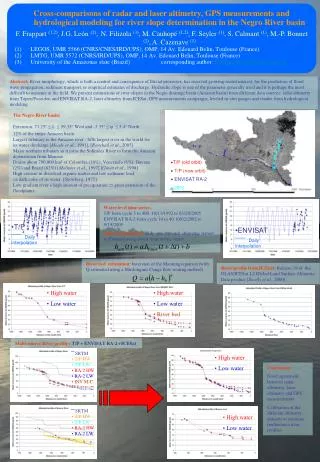
This study explores advanced rain flagging approaches using data from the Envisat RA-2 altimeter. We analyze periods when S-band sigma0 values exceed 23 dB, comparing them against MWR observations to assess anomalies in significant wave height (Hs) and sea surface height (ssh). Employing a dual-frequency rain flagging method, we establish thresholds to detect rain contamination effectively. Our findings indicate that differential attenuation can enhance rain studies and benefit climatology when synergistically combined with other satellite instruments.

E N D
Envisat RA-2 rain flagging Graham Quartly & Meric Srokosz
Heritage Rain flagging for TOPEX (Ku,C)
Sigma0 monitoring Periods when S-band sigma0 values are ~23 dB too high
Comparison to MWR All points Points with BT36 >200K Correspondence between attenuation events and high BT values
<< Rain Flagging >> Detection of rain Estimation of rain rate (storm studies, climatologies etc.) Finding anomalous / contaminated data (Automatic removal of bogus ssh, Hs values)
Automatic detection 1. One-point anomaly filter 2. Look at sh, sHs 3. Dual-frequency rain flag
Flagging on sh & sHs Threshold: mn + 3 s.d. = 0.12 + 0.007 Hs2 Threshold: mn + 3 s.d. = 0.60 + 0.04 Hs2
Dual-frequency rain flag Rain-contaminated if ‘significantly’ below mean relationship Here 0.5 dB and s0S ≤ 15 dB — Could use smaller threshold. — Could use 2.5 x Std. Dev. — Could extend over all s0 Also require MWR confirmation?
Effect on Hs Attenuation near leading edge leads to higher Hs and shift in range …
Conclusions Differential attenuation can be used for ‘rain flagging’. Threshold of 0.5 dB picks out most Hs and ssh spikes. Apart from when S-band goes AWOL, there is good s0 stability (track-to-track variation ~ 0.1 dB). Will make a contribution to ‘rain studies’ (Use of many DF altimeters give better climatology; synergistic use of RA-2 with MERIS and AATSR.)