Download
1 / 11
110 likes | 237 Views
Charlemagne, also known as Charles the Great, emerged from the Frankish Kingdom in the 7th century, following the decline of Frankish kings' power. As a strong warrior and devout Christian, he expanded his realm into what became the Carolingian Empire, culminating in his crowning as Roman Emperor in 800 AD. This period marked the fusion of Christian and Germanic traditions and sparked the Carolingian Renaissance, where learning and culture flourished thanks to the dedication of monastic communities. The Church played a pivotal role in this transformation.

E N D
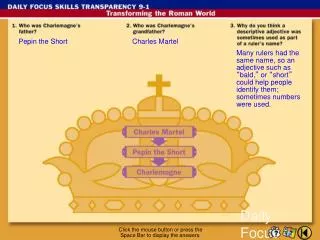
Pepin the Short Charles Martel Daily Focus Skills Transparency 1 Many rulers had the same name, so an adjective such as “bald,” or “short” could help people identify them; sometimes numbers were used. Click the mouse button or press theSpace Bar to display the answers.
Transforming the Roman World Germanic Kingdoms 500 AD Charlemagne
New Germanic Kingdoms • Germanic peoples began movinginto the lands of the Roman Empire around the 3rdCentury • Visigoths occupied Spainand Italy(Ostrogothslater took control) • Angles and Saxons- Britain • Saxons- Northern Germany • Franks- France • Longest lasting was the K. of the Franks • Clovisestablished it around 500 • Strong militaryleader • First Germanic ruler to convert to Christianity- won support of Roman Catholic Church
The Role of the Church • By the 4th C, Christianity had become the supreme religionof the RomanEmpire • Developed a system of organization • Priestshead local parishes • A group of parishes=bishopric • Headed by a bishop • A group of bishoprics=archbishopric • Headed by an archbishop • The Bishop of Rome came to claim he was the leaderof the Roman CatholicChurch (the Pope) • Based on the belief that Jesusgave Peter the keys to Heaven • Peter=1st Bishop of Rome (1stPope)
The Role of the Church • Most WesternEuropeans accepted the pope as leader, but his role was undecided • Pope Gregory I (590-604) extended the powerof the papacy • Took politicalcontrol over Romeand surrounding areas (Papal States) • Used Church revenuesto raise armies • Fought off the Byzantinesand the Lombards • Extended his power within the Church • Convertednon-Christians through the monasticmovement
The Role of the Church • Monksseparate themselves from worldly, everyday life to dedicate themselves to God • Monasticism=living the life of a monk • 6th C- St. Benedict founded an order • Divided the day into activities • Emphasize prayerand physical labor • All aspects of Benedictinelife were communal • An abbot(“father”) ruled each Benedictine monastery • Took a vow of poverty • Became the heroesof Christian civilization due to their commitment • Became the social workers of society • Monasteries became importantcenters of learning • Monks would spread Christianity • Missionaries= people sent out to carry a religiousmessage
The Role of the Church • Women • Could become nuns- dedicate their lives to God • Lived in convents, headed by abbesses • Many belonged to royalhouses • Only way for women to receive an education • The abbess Hildafounded a monastery in Whitby in 657 • Gave learningan important role • Educated 5 future bishops
Charlemagne and the Carolingians • 7th century- Frankishkings lost their power • Chief officersof the king took control • Pepinassumed the throne • Pepin’s son was Charles the Great (Charlemagne) • He was a strong warriorand statesman, and a devout Christian • He expanded the Frankish Kingdom into the Carolingian Empire(Westernand Central Europe) • 800- he was crowned Roman Emperor • Testifies to the enduringnature of the Roman Empire • Symbolized the coming together of the Christianand Germanicelements of society • The Popecrowned him Emperor
Charlemagne and the Carolingians • Charlemagne strongly supported learning • Led to the Carolingian Renaissance(rebirth) • Renewed interest in Latinculture and classical works (Greeksand Romans) • Monasteriesplayed an important role • Benedictine monkscopied Christian and Latin manuscriptsin writing rooms, called scriptoria • Most of the Romanworks we have today exist because of these Carolingianmonks