Understanding Ocean Waves: Anatomy, Types, and Their Impact on Energy Movement
Ocean waves are energy phenomena, not just water movement. They arise from wind, earthquakes, and volcanic activity, revealing their origins through their size and shape. Key traits include crests, troughs, wave height, wavelength, wave period, and frequency. Several factors influence their size, including wind speed and duration, fetch distance, and the effects of the Beaufort Wind Force Scale. Notably dangerous waves like Cyclops, Teahupoo, and Shipsterns showcase the ocean's power. Explore the dynamics of waves and their potential for sustainable energy.

Understanding Ocean Waves: Anatomy, Types, and Their Impact on Energy Movement
E N D
Presentation Transcript
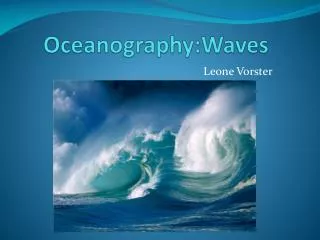
Oceanography:Waves Leone Vorster
What Are They? • Waves are actually energy. Energy, not water, moves across the ocean's surface • Tsunamis result when underwater earthquakes and volcanic eruptions disrupt the water's surface • A wave's size and shape reveals its origins • No two waves are identical, but they all share common traits
Traits of Ocean Waves • Crest: The highest part of the wave above the still-water line. • Trough: The lowest part of the wave below the still-water line • Wave Height:The vertical distance between the crest and the trough. • Wavelength: The horizontal distance between each crest or each trough.
Traits of Ocean Waves • Still-Water Line:The level of the ocean if it were flat without any waves. • Wave Period:The time it takes for two successive waves to pass a particular point. • Wave Frequency:The number of waves that pass a particular point in a given time period. • Amplitude:The amplitude is equal to one-half the wave height or the distance from either the crest or the trough to the still-water line.
Wave Size • Beaufort Wind Force Scale • The size of a wave depends on: • The distance the wind blows (over open water) which is known as the "fetch” • The length of time the wind blows • The speed of the wind. • The greater these three, the larger the wave.
3 Most Dangerous Waves • Cyclops (remote south coast Western Australia)
3 Most Dangerous Waves • Teahupoo (Tahiti)
3 Most Dangerous Waves • Shipsterns(Tasmania, Australia)
Extra Wave Information • Wave Simulator • Enchanted Learning – Tsunami • Powerful Ocean Waves Video • Ocean Waves – Sustainable Energy