Download
1 / 17
170 likes | 288 Views
This chapter explores key tools used in recombinant DNA technology, including restriction enzymes, gel electrophoresis, and DNA ligase. It explains how restriction enzymes cut double-stranded DNA into smaller fragments at specific restriction sites, creating sticky or blunt ends. Gel electrophoresis is discussed as a method to separate and purify DNA fragments based on size. The chapter also covers the creation of recombinant DNA through ligation, cloning strategies, and the application of genetic engineering in transgenic organisms. Furthermore, it addresses concerns about safety and environmental effects associated with biotechnology.

E N D
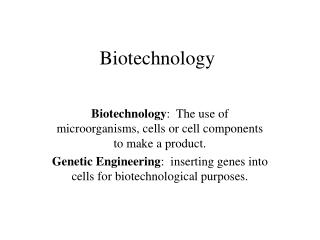
Biotechnology Chapter 13
Recombinant DNA • Tools used • Restriction enzymes • Gel electrophoresis • DNA ligase
Restriction enzymes • Cut double stranded DNA into smaller fragments • restriction sites • Sticky ends • Blunt ends
Gel electrophoresis • Separate and purify DNA fragments • After cutting the DNA by restriction enzymes • Placed in an electrical field • Phosphates are negatively charged so…
This causes DNA to move to the positive side of the cell • Smaller molecules can move faster than larger one • This causes DNA to separate into fragments So…
We get this information • The number of fragments • The size of the fragments • The relative abundance of a fragment
DNA ligase • Makes phosphodiester bonds between DNA fragments. • Allows recombinant DNA You will do this in lab
Cloning • Producing many identical copies of a particular DNA sequence • Transgenic cells are contain recombinant DNA
Model organisms for recombinant DNA • Bacteria • Yeast • Plant cells • Cultured animal cells
Vectors for recombinant DNA • Plasmids • Viruses
Genomic Libraries • Collection of DNA fragments that together comprise the genome of the organism. • cDNA – complementary DNA can be found in a cDNA library • Only genes from a particular tissue (snapshot)
Block translation • Antisense RNA • Used in some drugs for cancer treatment
Application • Expression vectors have all the appropriate characteristics for expression • Inducible promoter • Tissue specific promoter • Signal sequences
Medical products • Insulin • Human growth hormone
Breeding methods • The ability to identify specific genes • Ability to introduce any gene • Ability to generate new organisms quickly
Transgenic crops • Improved nutritional value • Adapted to environment
Concerns • Unnatural • Safety • Enviornmental effects