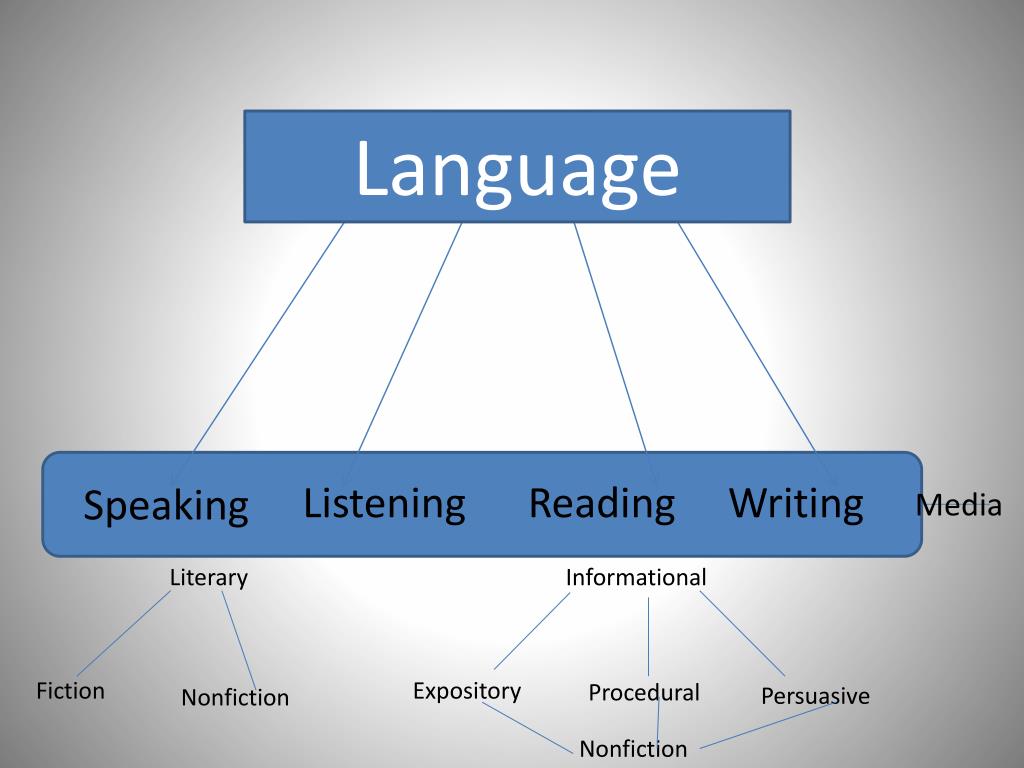
Language . Speaking. Listening. Reading. Writing. Media. Literary. Informational. Fiction. Expository. Procedural. Persuasive. Nonfiction. Nonfiction. Literary Elements. Important parts of stories. Plot diagram model/story map. Denouement/. WHETHER AND HOW CONFLICTS ARE RESOLVED
An Image/Link below is provided (as is) to download presentation
Download Policy: Content on the Website is provided to you AS IS for your information and personal use and may not be sold / licensed / shared on other websites without getting consent from its author.Content is provided to you AS IS for your information and personal use only.Download presentation by click this link.While downloading, if for some reason you are not able to download a presentation, the publisher may have deleted the file from their server.During download, if you can't get a presentation, the file might be deleted by the publisher.
E N D
More Related Content
Presentation Transcript
Language Speaking Listening Reading Writing Media Literary Informational Fiction Expository Procedural Persuasive Nonfiction Nonfiction
WHETHER AND HOW CONFLICTS ARE RESOLVED • Possible examples of conflict resolution: • Everybody wins • Fight/run away/avoid • Fight/resist • Death • Compromise • Someone wins: someone loses • Acceptance • Unresolved
Setting: • Time - When is the story taking place? • Place – Where is the story taking place? • Environment – What does it feel like? (e.g., weather, mood, social conditions) • Culture - What cultural influences are part of the setting? (e.g., geographic region, race, religion, etc.) • Historical background - What historical influences are part of the setting? (e.g., historical events, movements, time periods, etc.)
Plot continued • Setting: When and where a story takes place. • Suspense: Building tension in a story. You wonder, “What will happen next?” • Flashback: When a story is interrupted and we go back in time. • Dialogue: What is said between characters in a story. There are “quotation marks.” • Theme: The message that an author wants you to know about life, nature or society after reading the story. NOT THE MAIN IDEA!!! • Foreshadow: When the author gives clues about an event that may take place in the future. • Symbolism: Using an object to represent another idea. Example: a dove represents peace. A heart represents love.
Characters • Characters: • The people or animals in a story. • Antagonist: The character causing the problems in the story. • Protagonist: Main Character in the story • Traits: How you describe a character.- physical emotional , intellectual • Motivations: What causes a character to act or speak in a certain manner.
Conflict • Conflict: • Problem: What is wrong,. What needs to be solved. • Solution/Resolution:How the problem/conflict is solved. • 4 main types of conflict: • Character vs. self – The character must make a decision. • Character vs. character – The character has a problem with another character. • Character vs. nature – The character must overcome a natural disaster. • Character vs. society – The character has ideas different to society. School rules
Point of View • Point of view: How the story is being told. • First person: The narrator is a character in the story. Use “I”, “me” , we, “my.” etc. • Second Person: Use of “You” giving of directions (Speeches) • Third person: The narrator is NOT a character in the story. Use characters’ names, he, she they, etc.. Reporting
Advantages • Advantages of first person point of view: • •Credibility – • First-hand experience is more believable. • It is far more natural for a character to reveal her own thoughts. • Intimacy - the “I” narrator seems to address the reader directly from the heart, sharing his personal observations and insights with an interested listener.
Third Person/All Knowing • Third person/omniscient - the narrator tells the story in third person from an all-knowing perspective. The narrator knows everything about all the characters. • Third person/limited - the narrator restricts his or her knowledge to one character’s view or behavior
Advantage of third-person omniscient: • •Obvious freedom and unlimited scope • Disadvantage of third-person omniscient: • •Relative loss of involvement and intimacy
Advantage of third-person limited: • •Encourages personal connections to one character • Disadvantage of third-person limited: • •Surrenders the privileges of seeing and knowing everything and typically follows one character throughout the story, presenting only those incidents in which the character is involved • •The reader’s perception of other characters is colored by the narrator’s predispositions, prejudices, and personal limitations
Third Person • Subjective - perspective is restricted to one character including their inner thoughts and feelings • Objective - the narrator reveals only the actions and words without the benefit of the inner thoughts and feelings
Culture/Custom • -activities, ideas, beliefs, values, attitudes, behavior, dress, and language of a particular group of people • Culture determines what is acceptable or unacceptable, important or unimportant, right or wrong.
Values • Important and lasting beliefs shared by the members of a group of people about what is good or desirable and what is not. • Values influence behavior of an individual.
Beliefs • What you think to be true about concepts, events, people, and things.
Sensory Imagery • This is a technique used by writers that involve the 5 senses. I • See • Hear • Taste • Touch • Smell It draws the reader in and helps the reader a participate in the experience.
Words that tell. Sight • What would you see ? • What would it look like? Examples: old, frail, sunny, shy, hysterical, healthy, broken, fresh, tall, round,
Words that tell…Sound • What would you hear ? • What does it sound like? Examples: shout, thud, whistle, clatter
Words that tell…Taste • What would you taste ? • What does it taste like? Examples: sweet, burnt, buttery, salty, warm, crisp, tangy
Words that tell…Touch/Feeling • What does it feel like? • How does it feel? Examples: sharp, smooth, tickly, warm, fuzzy, dry
Words that tell…Smell • How does it smell? • What does it smell like? Examples: musty, fresh, spicy, piney
Now, see how many examples of Sensory Imagery you can find. “ Walls of thick vegetation rose up on all sides and arched overhead in a lacy canopy that filtered the light to a soft shade. It had just rained; the air was hot and steamy. I felt enclosed in a semitropical terrarium, sealed off from a world that suddenly seemed a thousand miles away.” - From Midnight in the Garden of Good and Evil by John Berendt
"The Most Dangerous Game" by Richard Connell "He leaped upon the rail and balanced himself there, to get greater elevation; his pipe, striking a rope, was knocked from his mouth. He lunged for it; a short, hoarse cry came from his lips as he realized he had reached too far and had lost his balance. The cry was pinched off short as the blood-warm waters of the Caribbean Sea closed over his head. "He struggled up to the surface and tried to cry out, but the wash from the speeding yacht slapped him in the face and the salt water in his open mouth made him gag “
Example of a Setting: • Crunch! Crunch! Crunch! Joe’s boots broke the forest’s silence. • A full moon peeked out from behind two clouds. • Tree shadows licked the snow drifts in its shimmering light. • Joe shivered as a cold gust of wind blew through his jacket.
Myth • Myth –Stories that were created to explain a belief or natural happening that people could not understand. • These stories included Gods and Goddesses.
Fable: • Fable – a brief story or poem that teaches a moral or lesson usually through animal characters.
Once Upon A Time… • Legend – a widely told story about the past that may or may not have any truth to it. • Fairy tale - a story about fairies or other mythical or magical beings. • Folk tale – a story originated by people that could not read or write and passed from person to person by word of mouth.
The face that launched a thousand ships • Epic - a long poem from ancient oral tradition, telling about the deeds and adventures of heroic or legendary characters.
External Features • Using the Table of Contents to locate main topics • Utilizing the Glossary to identify the unknown • Making use of Headings and Subheadings to locate information • Analyzing Graphic Features to support meaning • Using the Index to navigate text • Finding useful information in Captions and Footnotes
Persuasive Techniques • Methods a writer uses to make an audience think a certain way. • It appeals to: • Reason • Emotions • Respect for expert opinion
Aphorisms/proverbs • A statement of a general truth or principle • • • A winner never quits—a quitter never wins. • • • • • Failure to prepare is preparing to fail.