Download
1 / 34
340 likes | 448 Views
This presentation from the 35th Conference on Teaching and Leadership Excellence focuses on the essential roles of administrators and faculty in promoting student success. It discusses goal-setting practices linking course-level objectives to institutional outcomes, including persistence, graduation, engagement, and job placement. Effective assessment methods, both at the course and institutional levels, are explored to support students in achieving realistic academic and career goals. Emphasizing faculty-student interaction and financial literacy, this collaborative approach aims to enhance student outcomes and facilitate college completion.

E N D
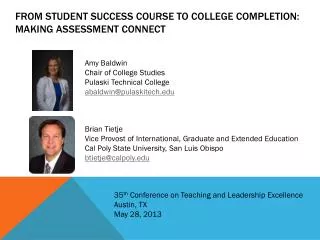
FrOM STUDENT SUCCESS COURSE TO COLLEGE COMPLETION: MakING ASSESSMENT CONNECT Amy Baldwin Chair of College Studies Pulaski Technical College abaldwin@pulaskitech.edu Brian Tietje Vice Provost of International, Graduate and Extended Education Cal Poly State University, San Luis Obispo btietje@calpoly.edu 35th Conference on Teaching and Leadership Excellence Austin, TX May 28, 2013
WHAT STUDENT SUCCESS GOALS do you want students to achieve? • ADMINISTRATOR • FACULTY
WHAT STUDENT SUCCESS GOALS do you want students to achieve? • ADMINISTRATOR • Persistence • Completion/graduation • Job placement • FACULTY • Engagement • Learning/mastery • Course progression
A Tale of two GOALS What FACULTY want What ADMINISTRATORS want
Connecting course-level goals to institutional goals COURSE level Institutional level The institution will score at the cohort average or better on student graduation and transfer rates from the IPEDS report. • Students will be able to • identify realistic • academic and career • goals for themselves.
Assessing Goal setting at the Course Level Quick assessment Assignment Mission statement and goals • Minute paper
GOAL SETTING: MInUTE PAPER • What does the acronym • SMART stand for in relation to • goal setting?
GOAL SETTING: ASSIGNMENT • Write a mission statement • Create two long-term academic goals with three short-term academic goals to support each long-term goal.
Assessing Goal setting at the INSTITUTIONAlLevel • Integrated Postsecondary Education Data System (IPEDS) • Community College Survey of Student Engagement (CCSSE) • College Scorecard
Connecting course-level data to institutional data COURSE level Institutional level Retention and graduation rates • Proportion of students who can develop SMART academic goals
Connecting COURSE-level goals to institutional goals COURSE level Institutional level The institution will score at the cohort average or better on The faculty-student interaction benchmark from the CCSSE report. • Students will be able to • actively engage with • their instructors both • within and outside the • classroom.
Assessing Faculty-Student Interactionat the Course Level Quick assessment Assignment Who’s in your circle/relationship-building assignment • Muddiest point • Think-Pair-Share
Faculty/Student Interaction: MUDDIEST POINT • What challenges are you • experiencing with making • connections with faculty and • staff at the college?
Faculty/Student Interaction: ASSIGNMENT • Identify three people in your network who are clearly supporting your academic goals. Include at least one faculty. • Describe a plan for strengthening your relationship with all three people.
Assessing FACULTY-STUDENT INTERACTIONat the INSTITUTION Level • Community College Survey of Student Engagement (CCSSE) • Student evaluations of faculty
Connecting course-level data to institutional data COURSE level Institutional level Proportion of students reporting that they discuss grades or assignments with an instructor often or very often (via CCSSE) • Proportion of students who can identify a faculty member in their support network and describe a plan for using that person a a resource
Connecting course-level goals to institutional goals Course level Institutional level The institution will maintain a student loan default rate below 10% as reported by the Department of Education Statistics. • Students will be able to • calculate the cost of • their education, • compare that cost to • their available resources, • and develop a plan for • closing the gap.
Assessing FINANCIAL LITERACY at the Course Level Quick assessment Assignment Financial aid literacy assignment • Directed response • Pre-test/post-test
FINANCIAL LITERACY: Pre- and Post-Tests PRE-TEST POST-TEST
FINANCIAL LITERACY: ASSIGNMENT • This is Rodney. He is a new student in • college. He just started college this • semester. He will be a full-time student • with a part-time job. • Help Rodney decrease his dependency • on loans, graduate more quickly, and • fulfill his goal of transferring to UALR.
Assessing financial LITERACYat the INSTITUtIONalLevel • Integrated Postsecondary Education Data System (IPEDS) • Department of Education Statistics
Connecting course-level data to institutional data COURSE level Institutional level Institutional student loan default rate • Proportion of students who can identify strategies for decreasing their dependence on student loans
Thank You FOR ATTENDING itsinthesyllabus.com Amy Baldwin Chair of College Studies Pulaski Technical College abaldwin@pulaskitech.edu Brian Tietje Vice Provost of International, Graduate and Extended Education Cal Poly State University, San Luis Obispo btietje@calpoly.edu 35th Conference on Teaching and Leadership Excellence Austin, TX May 28, 2013