Download
1 / 1
10 likes | 121 Views
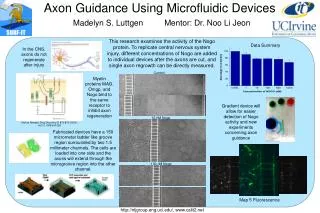
This research explores the inhibitory role of myelin proteins, specifically Nogo, in axon regeneration following central nervous system (CNS) injuries. Utilizing a novel microfluidic device with a 150 micrometer groove, axons are directed to grow through controlled environments while subjected to varying concentrations of Nogo. The study aims to enhance our understanding of axon guidance and regeneration mechanisms, paving the way for potential therapeutic strategies in CNS repair. The findings will offer insights into the challenges of promoting axon regrowth after injury.

E N D
Data Summary In the CNS, axons do not regenerate after injury Control Myelin proteins MAG, Omgp, and Nogo bind to the same receptor to inhibit axon regeneration Gradient device will allow for easier detection of Nogo activity and new experiments concerning axon guidance 10 nM Nogo Nature Reviews Drug Discovery2; 872-879 (2003); doi:10.1038/nrd1228 Fabricated devices have a 150 micrometer ladder like groove region surrounded by two 1.5 millimeter channels. The cells are loaded into one side and the axons will extend through the microgroove region into the other channel. 100 nM Nogo Map 5 Fluorescence Axon Guidance Using Microfluidic Devices This research examines the activity of the Nogo protein. To replicate central nervous system injury, different concentrations of Nogo are added to individual devices after the axons are cut, and single axon regrowth can be directly measured. Madelyn S. Luttgen Mentor: Dr. Noo Li Jeon http://nljgroup.eng.uci.edu/, www.calit2.net