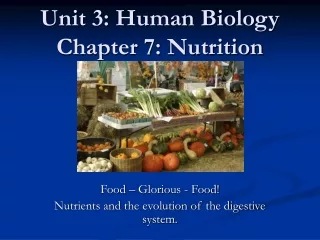
Understanding Nutrition's Role in Physical Fitness and Health
This chapter explores the critical connection between nutrition and achieving optimal physical fitness. It identifies the six essential nutrients—carbohydrates, proteins, fats, vitamins, minerals, and water—and discusses their roles in body maintenance, growth, and energy production. Various dietary problems, sources of essential nutrients, and the significance of calories are explained. The text emphasizes the importance of a balanced diet, understanding calorie content, and maintaining healthy dietary practices to support overall health and fitness.

Understanding Nutrition's Role in Physical Fitness and Health
E N D
Presentation Transcript
Objectives • Understanding the relationship of good food nutrition to achieving a high level of physical fitness. • Indentifying the six basic nutrients • Understand common dietary problems. • Recognizing foods that are a good source of essential nutrients. • Understanding minerals.
What is Nutrition ? ? ? • The process by which the body uses food for maintenance of life, growth, normal functioning of every organ and tissue, and the production of energy
Food • Material of plant and animal origin which nourishes & maintains the human body and enables the body to function & grow. • Food is composed of nutrients. • May contain 6 essential nutrients.
Food • Food provides fuel (energy) in the form of calories. • Food also provides the basis for sound healthy skin, teeth, hair, muscle, and bones.
What Is a Calorie? • All foods contain calories • Food energy in noted in the form of calories. • The number of them depends on the specific nutrients and the amount of food in each. • Common measurement used to express potential energy of food. By product of chemical reactions in the body. • Calorie - A unit of heat equal to the amount of heat required to raise the temperature of one kilogram of water by one degree at one atmosphere pressure • You should eat a variety of high quality foods. • No single food groups provides all essential nutrients.
Calories per gram 1 gram of fat = 9 calories 1 gram of protein =4 calories 1 gram of carbohydrates=4 calories.
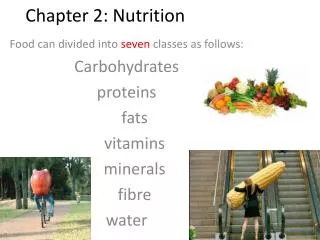
Essential Nutrients • Carbohydrates • Protein • Fats • Minerals • Vitamins • Water
6 Basic Nutrients (Carbohydrates) • Function – Major source of energy; supplies fiber. • Sources – Fruits, vegetables, grains, and cereals • Diet Recommendations - 58% +. 48% from complex carbohydrates. 10% from simple sugars
Carbohydrates • Major source of energy which is supplied in the form of sugar. • Fruits, veggies, grains, cereals. • 58% • Supplies Fiber • Intestinal house cleaner • Lowers risk of colon cancer and lowers cholesterol • Water soluble/ insoluble • Only found in plants • RDA-25-50grams daily • Water soluble • Found only in plant food.
Carbohydrates • Simple sugars • (Monosaccharides) • Fructose-fruit sugar • Glucose- corn sugar/ blood sugar. • Two sugars-(Disaccharides) • Sucrose-Table sugar, cane sugar • Lactose-milk sugar • Maltose-Malt sugar • Multiple Sugars • Polysaccharides • Starch-Plant sugars • Cellulose-Plant fiber(non-digestible)
Proteins • Aids in growth maintenance and tissue repair • Found in chicken, fish, meat, and low-fat dairy products: eggs, fish, and beans • Recommended percentage is 12% • Made of amino acids • Body manufacturers some • Others are found within foods • EAA – Animal sources are complete and plant sources are incomplete • 40 – 60 grams needed per day
Fats • Source of stored energy • Carries fat soluble vitamins • 20 – 30% recommended daily • Monounsaturated -Healthy type; liquid for m found in vegetables • Polyunsaturated- Increase risk of heart disease • Saturated - Solid form; animal source contributes to heart disease • P.133
Cholesterol • Found in foods that come from animals • Excess can build up on linings of arteries and cause heart attack • 2 types: HDL and LDL • HDL(high density lipoproteins) - the good one-picks up extra cholesterol/helps eliminate. • LDL – (low density lipoproteins)the bad one-deposits extra in the lining of arteries.
Ways to Lower Cholesterol • Reduce saturated fats • Avoid fatty meats • Avoid foods that contain large amounts of hydrogenated vegetable oils • Don’t eat skin from meats • Limit foods high in cholesterol • See chart on p 133 • Drink fat free milk • Eat unsaturated fats • http://www.healthination.com/Videos/Cholesterol
Minerals • Important in activating numerous reactions in the body • 2 general body functions - building and regulating food sources
Vitamins • Function - aid in absorbing and using nutrients • Food sources - variety of foods • RDA - guideline for how much you should take of each vitamin • 2 groups: fat and water soluble • Fat soluble-Vit -ADEK • Water soluble- B,C
Water • Function - helps regulate body temperature, digest food, excretion, glandular, secretion, and formation of blood plasma • Sources - beverages and liquids in foods • 2/3 quarts daily