Application Scenario
This document explores the architecture of MIMO MAC systems, focusing on the trade-offs between diversity and multiplexing. It discusses the implications of using multiple transmit and receive antennas, the performance metrics such as average frame error rates, and service rates under various conditions. The analysis also highlights the importance of dynamic resource allocations based on the class of service, along with optimization methods for achieving optimal scheduling. Key references include the work by Tse et al. on the diversity-multiplexing tradeoff in multiple-access channels.
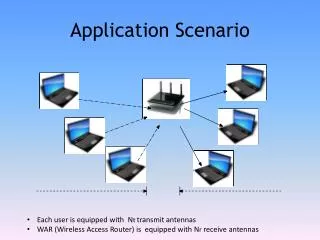

Application Scenario
E N D
Presentation Transcript
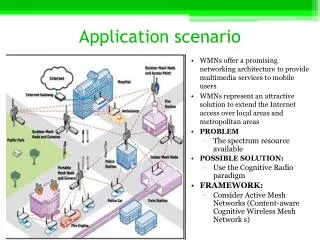
Application Scenario • EachuserisequippedwithNttransmitantennas • WAR (Wireless Access Router) isequippedwithNrreceiveantennas
System’s Architecture VBR media Encoder V(t) Loss-affected MAC queue VBR media Decoder
Physicallayerconfiguration D.N.Tse, P.Viswanath, L.Zheng,’’ Diversity-Multiplexing Tradeoff in Multiple-Access Channels’’, IEEE Tr.onInform. Theory, vol.50, no.9, pp.1859, 2004.
Diversity-vs-Multiplexing-vs-SDMAtradeoff • The best diversity-multiplexing curve attainableby the MIMO MAC channel i-thaverage Frame Error Rate at the MAC layer Piecewiselinear curve
MIMO MAC Packet loss MIMO MAC service rate
Multiple UserSystems MISO System MIMO System Joint optimization Dynamic resource allocations Backbone Access Point Client Device
MISO Systems - Multiplexer Queue weights depending on the Class of Service of the different input streams . . . . Weights . . a1 S1 Wireless channel a2 Optimization problem S2 s(t) aM SM 7
The radiatedenergies and the system state partitioningfor the jointlyoptimalscheduler 8