Gender Roles and Society in the Ancient Maya Civilization (2000 BC - 1600s)
Explore the intricate gender roles and societal structure of the Ancient Maya civilization from 2000 BC to the 1600s. Men were primarily hunters, farmers, and warriors, while women focused on child-rearing, weaving, and some farming. The Mayan kings, believed to be divinely appointed, ruled from monumental pyramid structures. The culture was rich in religious beliefs, with a pantheon of gods and practices like human sacrifice. Innovations such as glyphs and calendars played vital roles, while trade and warfare were integral to their society. Discover the remnants of this powerful civilization in modern-day Central America.

Gender Roles and Society in the Ancient Maya Civilization (2000 BC - 1600s)
E N D
Presentation Transcript
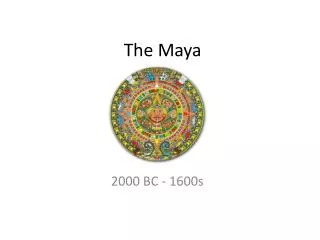
The Maya 2000 BC - 1600s
Gender Roles & jobs • Traditional roles in Mayan society: • Men = Hunting, farming, warriors • Women = Cared for kids, weaving, some farming
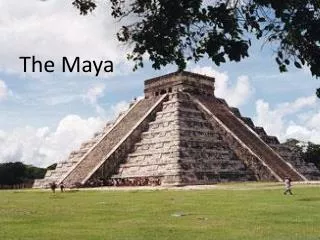
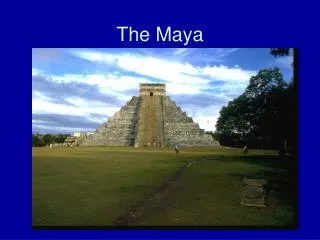
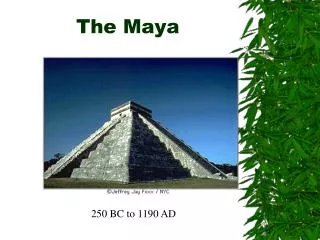
Government • A King (ajaw) ruled • Power passed down through royal family • The royal family and king were believed to have been given the right to rule by gods • Lived in giant pyramid structures
Religion • Believed in a variety of gods (Ex: god of the underworld, god or the crops…etc) • Believed the sky and planets would help them predict future events • Practiced human sacrifice as an offering to the gods
Environment or natural resources • Farmed many things including maize (corn), squash, beans, and chili peppers. • Hunted animals such as deer and monkeys. • Royalty were able to have cocoa beans. • Terraced (layered) their crops and dug canals for water.
Migration, trade or conflict • Mayans believed that going to war was part of life. • They believed that observing the stars would tell them the best time to go to war. • Sometimes alliances were made and gifts were presented as peace offerings
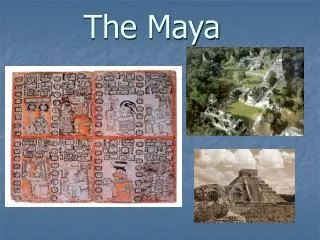
Innovation • Glyphs (early Mayan picture writing) was used to keep track of major events in Mayan society. • A calendar was created to help chart when to plant crops, go to war and when to have religious ceremonies.
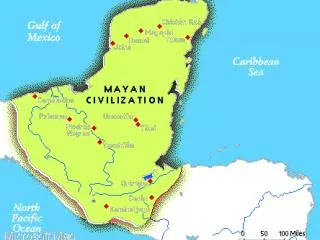
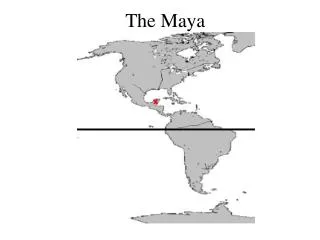
Other information • Mayan ruins can be found today in Mexico and many Central American countries. • Mayan civilization the most powerful from 250 AD- 900 AD • After this Mayan civilizations started disappearing: cause unknown. • Spanish explorers invaded and destroyed Mayan records and culture in the 1500s.