High-Temperature Micromanipulation in Environmental Scanning Electron Microscope (ESEM)
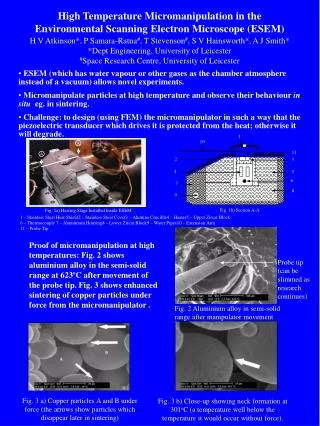
This study explores high-temperature micromanipulation within an Environmental Scanning Electron Microscope (ESEM). Utilizing water vapor or gases instead of a vacuum, ESEM facilitates novel experiments to micromanipulate materials at elevated temperatures, such as during the sintering process. The design challenge entails protecting the piezoelectric transducer that drives the manipulator from excessive heat to prevent degradation. Results demonstrate successful manipulation of aluminum alloys and copper particles, showcasing enhanced sintering under applied force, thereby advancing the understanding of material behavior in real-time at high temperatures.

High-Temperature Micromanipulation in Environmental Scanning Electron Microscope (ESEM)
E N D
Presentation Transcript
1 10 A 11 A 2 3 4 5 6 7 8 9 Fig. 1b) Section A-A Fig. 1a) Heating Stage Installed Inside ESEM 1 – Stainless Steel Heat Shield2 – Stainless Steel Cover3 – Alumina Crucible4 – Heater5 – Upper Zircar Block 6 – Thermocouple 7 – Aluminium Housing8 – Lower Zircar Block9 – Water Pipes10 – Extension Arm 11 – Probe Tip High Temperature Micromanipulation in the Environmental Scanning Electron Microscope (ESEM) H V Atkinson*, P Samara-Ratna#, T Stevenson#, S V Hainsworth*, A J Smith* *Dept Engineering, University of Leicester #Space Research Centre, University of Leicester • ESEM (which has water vapour or other gases as the chamber atmosphere instead of a vacuum) allows novel experiments. • Micromanipulate particles at high temperature and observe their behaviour in situ eg. in sintering. • Challenge: to design (using FEM) the micromanipulator in such a way that the piezoelectric transducer which drives it is protected from the heat; otherwise it will degrade. Proof of micromanipulation at high temperatures: Fig. 2 shows aluminium alloy in the semi-solid range at 623ºC after movement of the probe tip. Fig. 3 shows enhanced sintering of copper particles under force from the micromanipulator . Probe tip (can be slimmed as research continues) Fig. 2 Aluminium alloy in semi-solid range after manipulator movement Fig. 3 a) Copper particles A and B under force (the arrows show particles which disappear later in sintering) Fig. 3 b) Close-up showing neck formation at 301oC (a temperature well below the temperature it would occur without force).