The Evolution and Phylogeny of Life: Insights from Darwin and Early Theorists
This course delves into the origins of evolutionary theory, highlighting key figures such as Erasmus Darwin, Jean-Baptiste Lamarck, and Charles Darwin. We explore the evolution of thought from ancient philosophies to modern understandings, focusing on the monumental works that shaped our comprehension of natural selection—especially Darwin's "On the Origin of Species." Additionally, we'll examine the contributions of Alfred Russel Wallace and the implications of gradualism versus punctuated equilibria in the context of evolutionary biology.

The Evolution and Phylogeny of Life: Insights from Darwin and Early Theorists
E N D
Presentation Transcript
Evolution and Phylogeny BIOL240.002 Zoology 25 August 2014
The Origin of the Concept of Evolution • Darwin • Erasmus Darwin, that is (grandfather of Charles) • b. 1731, d. 1802 • London-area physician • Naturalist • Inventor • Poet
Jean Baptiste Lamarck • b. 1744, d. 1829 • PhilosophieZoologique (1809) • Included chapter on evolutionary change over generations • “Use and disuse” • Giraffe necks • Egret legs • Blacksmith children • Lack of legs in snakes
Robert Chambers • Scottish pamphleteer • Anonymous author of Vestiges of the Natural History of Creation (1845) • Theological view of evolutionary change over time in living organisms
Charles Robert Darwin • b. 1809, d. 1882 • Father Robert Darwin, a London-area physician • College: medicine (Edinburgh), then theology (Cambridge) • 1831-1836: voyage on the H.M.S. Beagle • Mapping of South America and oceanic island groups
Voyage of the H.M.S. BeagleDec. 1831 – Oct. 1836 Fig. 1.5 p. 7
John Stevens Henslow • Darwin’s professor at Cambridge (botanist, zoologist, geologist, paleontologist, etc.) • Suggested him for the post • Corresponded with Darwin and received his specimens during the voyage
Darwin Timeline • 1836—Return to England • 1837—Marriage and retreat to Downe —Opens first private notebook on the “species question” • 1838—“Eureka Moment” while reading Thomas Malthus’ essay On Population(1798)
Malthus and the Idea forNatural Selection • Gist: Human populations grow more rapidly than does their capacity to feed themselves • Darwin’s four observations: • a) Variation • b) Inheritance • c) Variation’s role in survival and reproduction • d) Organisms produce more offspring than the environment can support
Darwin’s “Struggle for Existence” • Determination of which variants survive, in the face of the death made necessary by environmental limitations on population growth • Philosopher Herbert Spencer: “Survival of the Fittest”
Darwin Timeline • 1842—First draft of theory (35 pp.) • 1844—Second draft (230 pp.) • Shared second draft with eminent geologist Sir Charles Lyell and botanist Joseph Hooker
Darwin Timeline • 1846-1854—4 volumes on barnacle taxonomy • 1856—Lyell and Hooker convince Darwin to start “big book” • To be ~1500 pp.
Alfred Russel Wallace • b. 1823, d. 1913 • Amazon expedition, 1848-1852 • Southeast Asian islands expedition, 1854-1862 • Sent Darwin a manuscript in 1858
Wallace’s 1858 Manuscript • Briefly outlined the concept of evolution by natural selection • Wallace asked Darwin to forward the ms. to Lyell • The ms. and a letter of Darwin’s were both read at a scientific meeting • 1859: Origin of Species • “Just” 500+ pages
Ernst Haeckel’sTree of Life Fig. 1.9 p. 10
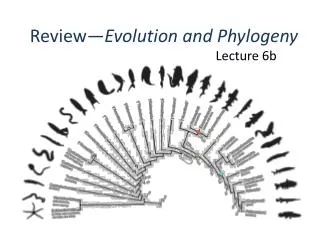
A Phlyogeny of Antelopes Fig. 1.13 p. 15
Diversity Through Time Fig. 1.15 p. 18
Gradualism vs. Punctuated Equilibria Fig. 1.25 p. 25 Fig. 1.26 p. 25