Download
1 / 26
260 likes | 398 Views
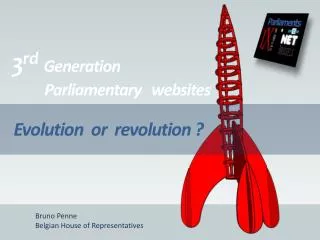
3 rd Generation Parliamentary websites Evolution or revolution ?. Bruno Penne Belgian House of Representatives. “ 3 rd generation Parliamentary websites”. Adding new comm channels Tailored info for targeted audience Increasing participation Increasing your ‘success rate’,

E N D
3rdGeneration Parliamentary websites Evolutionorrevolution ? Bruno Penne Belgian House of Representatives
“3rdgenerationParliamentary websites” • Adding new comm channels • Tailored info for targeted audience • Increasing participation • Increasing your ‘success rate’, • Remain relevant as a website , • Extend your web presence
“Evolutionorrevolution” FacebookrevolutionWhat is the revolutionabout ? “Ornamentalorfundamental” - Representativedemocracyunder stress ( vs direct democracy ) - Website loosingauthority ( monopoly ) - Webmaster loosingcontrol
“generation Y” • Technology Stops being technology(new normal) • Target group Becomes community - individual • Push User( you ) in control • Want it all Fast, not perfect, good enough • Want it now Zero tolerance technical failure • Privacy Complete transparency
“generation Y”socialmedia Usage of Social media : Total transparency Accountibility Authority • Direct dialogue
Revolution generation Y Evolution adapt to global web presence (domino effect) • New type of clients… askingfor a new ‘informationstrategy’ … askingfor a new ‘communicationstrategy’ • New strategies… askingforchanges in organisation ? … dealingwithtechnology in a otherwaytechnologystrategy ! clouds & webservices
1997 : technologydrivenchange • Medium is the message • Content & information is king • ControlledbyParliament, ‘webmaster’ • Technologysupportingparliamentaryprocesses ( Parliament 1.0 ) • now : user drivenchange (newnormal) • Response is the message • Contact& interactionis king • User in control • Technologymeetsparliamentaryactivities( Parliament 2.0 )
“communication features” • Sections of the seminar • No continuous spectrum groupedby goal • groupedbyintendedaudience
New ways to deliver • parliamentary info • Reach “served audience” better. • New ways to deliverexistinginformation • Deliveringthroughnewchannelsorformats • Schedule the delivery ( daily, weekly, … ) • Delivery via filtering info (facets)
Extend the reach of your • internet-presence, • Reach the “unserved audience” • Translate technicalcontent (editorial teams) • Tailorcontent to communities (social media) • Addnewnon-technicalcontent (blogs) • Filter contentforspecificgroups (subsites)
Narrow the gap between thecitizen and parliamentary • decision making. • Allowcitizens to commentonexistingparl. data • (participation/crowdsourcing/feedbackforms) • Allowcitizens to start initiatives (e-petition) • Allowcitizens to debate and participation(forum)
Thanx + bruno.penne@dekamer.be