Download
1 / 13
130 likes | 233 Views
Explore evolutionary trees depicting shared derived characteristics, the Linnaean taxonomic system, and the unique traits of kingdoms Animalia, Plantae, Fungi, and more.

E N D
The Diversity of Life Chapters 2, 3
Objectives • Be familiar with an evolutionary tree • Be familiar with the Linnaean taxonomic system of classification • Recognize the different Kingdoms of Life • Describe the unique characteristics of each kingdom
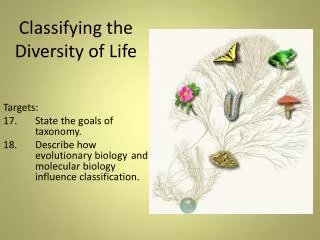
Evolutionary Trees • Evolution is observable change in an organism over time • Evolutionary trees depict relationships between organisms over time • Where branches meet, two or more organisms shared a common ancestor
Evolutionary Trees • Evolutionary trees depict shared derived (evolved difference) characteristics • Derived differences allow us to distinguish different groups of organisms
Classification • Taxonomy is a branch of science that attempts to organize the many diverse forms of life • Linnaean system is most widely used • Carolus Linnaeus1707-1778
Taxonomic Categories • Kingdom Animalia • Phylum Chordata • Class Mammalia • Order Primates • Family Hominidae • Genus Homo • species sapiens • King Phillip Could OnlyFindGerman shepards Kingdom level is most general while species level is most specific
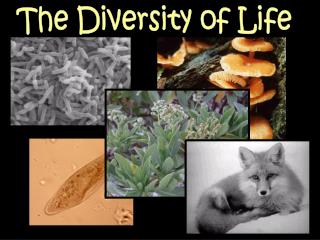
The Three Domains andSix Kingdoms of Life • Based on DNA evidence three Domains are recognized • Shared derived characteristics enable these domains to be broken into six Kingdoms
Bacteria and Archaea • Kingdom Bacteria • Prokaryotic: no organelles • Often disease causing • Archaea • Prokaryotic • Extremophiles • Live in weird habitats like hot springs and super cold environments
Protista • Diverse group of eukaryotic organisms • Most protists are unicellular. • Protist groups are predominately organized by feeding method plus other unique characteristics.
Plantae • Multicellular eukaryotes with at least a tissue level of organization • Cell wall • Autotrophic by photosynthesis; use chlorophyll a & b • Store food reserves as starch • Terrestrial (evolved on land).
Fungi • Multicellular eukaryotes • Feed as heterotrophs by absorption (Saprotrophic) • Body called mycelium made up of hyphae • Sexually reproduce via spores (resist drying out)
Animalia • All multicellular • Heterotrophic nutrition by ingestion • Diploid adult • Reproduction is usually sexual • Embryonic development often used to taxonomically classify animal groups