Download
1 / 17
170 likes | 279 Views
This project presents the design of a Kalman observer to estimate state variables for engine speed limitation in watercrafts. The objective is to improve engine speed control by accurately estimating load torque and engine speed through a state estimator. The Kalman filter is employed to provide accurate estimates in the presence of noise, enhancing the reliability of engine speed control systems. Experimental results demonstrate the effectiveness of the proposed method, highlighting its application across various domains, including aerospace and marine navigation.

E N D
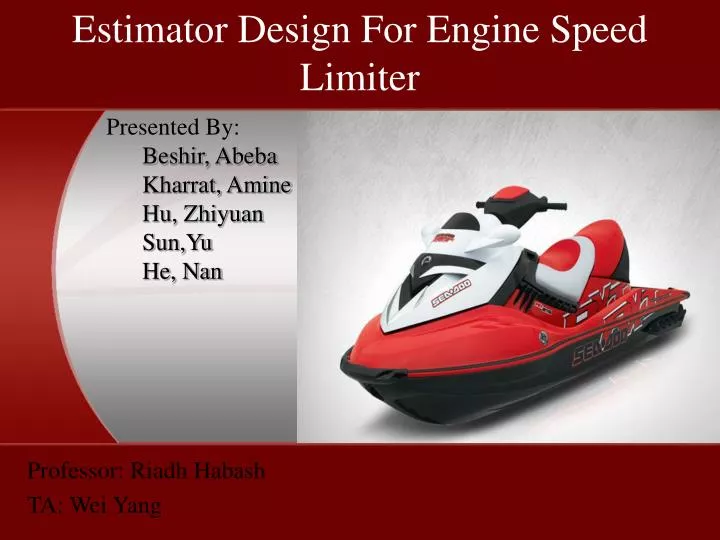
Estimator Design For Engine Speed Limiter • Presented By: • Beshir, Abeba • Kharrat, Amine • Hu, Zhiyuan • Sun,Yu • He, Nan Professor: Riadh Habash TA: Wei Yang
Contents • References • Background • Project Objective • Kalman Observer & Design • Experiment & Results • Conclusion
References • Engine Speed Limiter for Watercrafts • Philippe Micheau, R. Oddo and G. Lecours, from IEEE Transaction on Control Systems Technology VOL 14, NO 3, May 2006. • Engine Speed Control • Peter Wellstead and Mark Readman, control systems principles.co.uk • An Observer-Based Controller Design Method for Improving Air/Fuel characteristics of Spark Ignition Engines • By Seibum B. Choi and J. Karl Hedrick, IEEE TRANSACTIONS ON CONTROL SYSTEMS TECHNOLOGY, VOL. 6, NO. 3, MAY 1998 • http://www-ccs.ucsd.edu/matlab/toolbox/control/kalman.html?cmdname=kalman • http://auto.howstuffworks.com/engine1.htm • http://www.cs.unc.edu/~welch/kalman/ • Kalman Filter Tutorial
Background • 3 cases: watercraft propeller: Fully loaded (completely submerged) Partially loaded (partially submerged) Unloaded (completely emerged)
Project Objective • Design observer to estimate state variables: • Load Torque (Tload) • Engine Speed (N)
Observer (State Estimation) y(t) Plant Observer (state estimator) xhat(t) u(t) Xhat(t) = Nhat, Tloadhat (2 state variables) u(t) = Teng y(t) = N, Tload (2 outputs)
System Modeling (cont’d) • To estimate TLoad.
Kalman Filter • Estimates the state of a system for measurements containing random errors (noise). • Relatively recent development in filtering (1960)
Kalman Filter (Cont’d) Circles -- vectors, Squares -- matrices Stars -- Gaussian noise with the associated covariance matrix at the lower right. Fk -- state transition model Bk -- control-input model wk -- the process noise
Kalman Filter (Cont’d) Kalman Filter phases:
Experiment & Results Input Data (Teng)
Experiment & Results (Cont’d) Output Data (N, TLoad)
Conclusion • Kalman filter provides good estimate of state variables in presence of noise/disturbance. • Advantages: • Can achieve virtually any filtering effect • Forecasting characteristics using Least-Square model • Reduce “False alarms” (filter disturbances) • optimal multivariable filter
Conclusion (Cont’d) • Examples of application: • aerospace; • marine navigation; • nuclear power plant instrumentation; • demographic modeling; • manufacturing, and many others. • Limitations/ Future improvements: • Speed: filter speed is limited by the system architecture • Cost