The Election of 1824 and 1828: Andrew Jackson's Rise Amidst Sectional Conflict
150 likes | 265 Views
The elections of 1824 and 1828 marked a significant turning point in American politics, particularly with Andrew Jackson's emergence as a leading figure. The 1824 election, characterized by sectionalism, saw no candidate win a majority, leading to John Quincy Adams' controversial selection. Jackson, deemed a "common man," rallied support for the 1828 election, transforming the Democratic-Republican Party into the Jacksonian Democrats. This period was also marked by intense mudslinging, the spoils system, and the Nullification Crisis, showcasing the tensions between state and federal power.


The Election of 1824 and 1828: Andrew Jackson's Rise Amidst Sectional Conflict
E N D
Presentation Transcript
The Election of 1824 and 1828 • Traditionally, presidential candidates were selected at caucuses, and that would be the party's candidate • caucus- private meeting of party members • The Republican Caucus selected William Crawford of Georgia as their candidate • However, due to sectionalism, other sections of the countries selected their own candidates
Election of 1824 • However, due to sectionalism, other sections of the countries selected their own candidates • John Quincy Adams in the NE, Andrew Jackson in the West
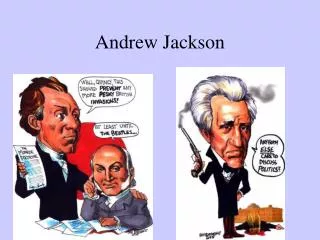
Election of 1824 • When the election was over, no one was the clear winner • Jackson had won the most votes, but not a majority • When no candidate wins a majority of the electoral college vote, the decision belongs to the House of Representatives that selected John Q. Adams
Election of 1824 • The House based their decision upon advice from Henry Clay • Problem: Clay was later named Adams' Secretary of State • "Corrupt bargain?"
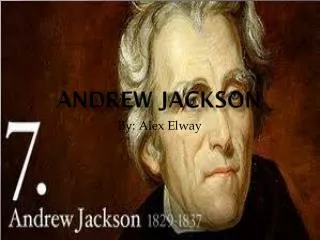
Election of 1828 • Jackson and the Democratic-Republicans were outraged about the election of 1824 and immediately began to prepare for 1828 • Thanks to Martin Van Buren, the party reformed itself into the JacksonianDemocrarts • They fairly easily won the 1828 election thanks to support from the Southern and Western states
Election of 1828 • Both parties mudslinging • Mudslinging – making wild charges and lies about a candidate • The Jacksonian Democrats: • a. said Adams was out of touch with the common people • b. coined the phrase “Adams can write, but Jackson can fight” • c. gave Jackson the nickname “Old Hickory”
National Republicans (old D-Rs): • a. called Jackson crude and uneducated • b. labeled him as a gambler and a brawler • c. called him a murderer (fought in duels)
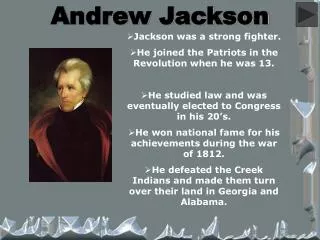
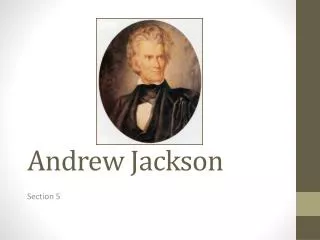
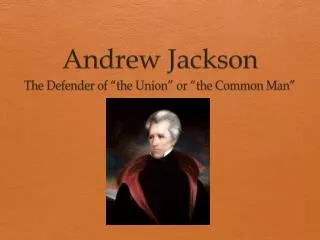
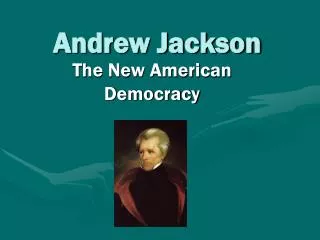
Jackson Takes Charge • Jackson was a “common man” • Thus he wanted to change how the national gov't functions, it favored the rich and he wanted to make it simple • Did not utilize his cabinet, rather he took advice from his friends • this group of friends became known as the “Kitchen Cabinet”
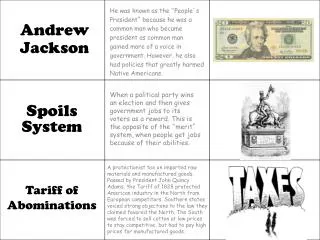
Spoils System • spoils system- process of new president rewarding supporters with jobs in the gov't • Pres. Jackson was accused of abusing this system • Jackson's argument was that “to the victor, goes the spoils”
Tariff of Abomination • South Carolina grew very angry about the Tariff of 1828 • it raised the prices of manufactured goods • the tariff was created to help North Eastern manufacturing • raised the prices of imported goods, making them more expensive than American Goods
Tariff of Abomination • They threatened to secede from the US if this tariff was not reduced • secede-break away • The VP, John C. Calhoun (of S.Carolina) did not want this to happen, so he suggested nullification • nullification- rejection of federal law
The Nullification Crisis • Two of the most gifted speakers in Congress squared off in a debate over the ability for a state to nullify • Hayne argued that the states had created a constitution and therefore had the right to nullify • Webster said the national gov't gets it power from the people, and not from the states
The Nullification Crisis • Jackson was able to get Congress to lower the tariff, but S. Carolina was still not happy • In fact, South Carolina readied for war to disunion • Jackson responded by calling disunion “treason” • Jackson got Congress to pass the Force Bill, which gave him the power to use the navy and army to collect the tariff
The Nullification Crisis • The combination of the Force Bill, and the signing of a new lower tariff ended the nullification crisis, thus holding the Union together, for now