Download
1 / 1
20 likes | 167 Views
This study investigates the sensitivity of air quality models to various physics options using an ensemble of eight members generated by varying WRF-ARW physical parameterizations. It focuses on summer 2006 ozone events in the northeastern U.S., examining how emissions models and air quality forecasts respond to changes in model physics. Key questions include the sensitivity of emissions models and the adequacy of forecast spread to capture uncertainty. The research is conducted by Debra Baker, a PhD student at the University of Maryland under the supervision of Eugenia Kalnay.

E N D
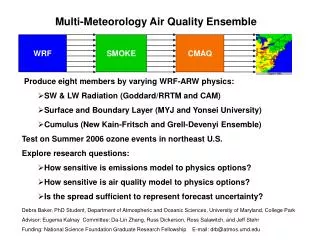
Multi-Meteorology Air Quality Ensemble WRF SMOKE CMAQ Produce eight members by varying WRF-ARW physics: • SW & LW Radiation (Goddard/RRTM and CAM) • Surface and Boundary Layer (MYJ and Yonsei University) • Cumulus (New Kain-Fritsch and Grell-Devenyi Ensemble) Test on Summer 2006 ozone events in northeast U.S. Explore research questions: • How sensitive is emissions model to physics options? • How sensitive is air quality model to physics options? • Is the spread sufficient to represent forecast uncertainty? Debra Baker, PhD Student, Department of Atmospheric and Oceanic Sciences, University of Maryland, College Park Advisor: Eugenia Kalnay Committee: Da-Lin Zhang, Russ Dickerson, Ross Salawitch, and Jeff Stehr Funding: National Science Foundation Graduate Research Fellowship E-mail: drb@atmos.umd.edu